

 Suche
Suche

Regardless of whether you are a leisure or elite runner, the inclusion of a variety of core exercises in your training program can lead to significant improvements in your running shape.
So that distance runners can maintain their attitude and performance, the stability and strength of the core is of crucial importance. It also helps to promote effective running form and movement efficiency, especially if you run for a long time. The core, which consists of approximately 30 muscles in the stomach, pelvis, lower back and hip, controls the position and movement of the fuselage above the pelvis and stabilizes the spine while charging and movement. In activities such as running, an effectively functioning core improves the muscle balance and can minimize the risk of injuries and overuse.
While running, when the core fulfills its task to stabilize the fuselage and maintaining the keeping of the posture, the hips, knees, ankles and feet can effectively function and floor reaction forces (forces that act on the body when the foot touches the floor) can adequately absorb and distribute. This reduces the stress and compression of the joints and the movement becomes more controlled and efficient.
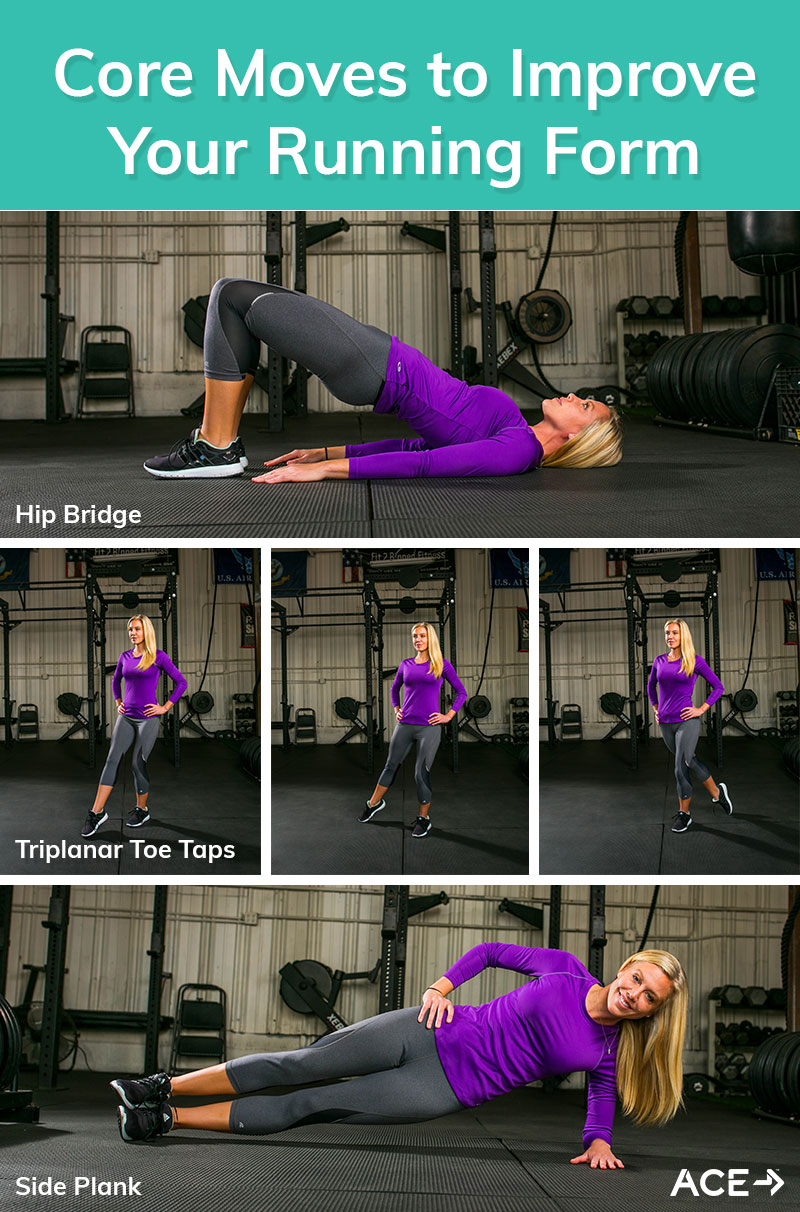
Here are three core exercises that you can integrate together with progress and regressions into your training program. Each exercise aims to improve stability, endurance and power of the core. Perform each exercise for up to 30 seconds and increase the intensity by adding progressions. The duration can be extended up to a minute. However, note that the goal is to improve the function. Therefore, the duration should only be extended if you can reach the right shape.
Hip / glute bridges
Focus:Stability and mobility, core stability, activation and strengthening of the buttock muscles
- Legen Sie sich mit den Füßen flach auf den Boden und den hüftbreit auseinander liegenden Knien auf den Rücken.
- Spannen Sie Ihre Bauchmuskeln an (als würden Sie sich darauf vorbereiten, in den Bauch geschlagen zu werden) und heben Sie Ihre Hüften nach oben, während Sie die Gesäßmuskeln drücken. Vermeiden Sie es, Ihren unteren Rücken übermäßig zu krümmen.
- In die Ausgangsposition zurückkehren und wiederholen.
Progress:One -legged, banded stability ball (back on the ball or feet on the ball) or marching buttocks
Side plank
Focus:Core stability and endurance as well as stability of hip
- Beginnen Sie, indem Sie auf Ihrer Seite liegen und die Ellbogen unter den Schultern positionieren.
- Heben Sie Ihre Hüften an und stapeln oder taumeln Sie Ihre Füße.
- Spannen Sie die Bauchmuskeln an und drücken Sie die Gesäßmuskeln zusammen.
- Halten Sie Ihren Kopf in einer Linie mit den Schultern und die Augen sind geradeaus gerichtet. Halten Sie und wiederholen Sie auf der anderen Seite.
Progress:Lift the hip or stretch the thighs
Regression:Knee bent
Triplplanar toe taps
Focus:Stability of hip and strengthening the buttock muscles
- Beginnen Sie mit hüftbreit auseinander liegenden Füßen.
- Balance auf einem Bein. Tippen Sie mit dem verlängerten Bein mit den Zehen nach vorne, zur Seite und diagonal hinter sich, während Sie das Knie am stehenden Bein leicht beugen.
- Wiederholen Sie auf der anderen Seite.
Progress:Banded or on Bosu
Regression::Stand next to a chair or a wall to hold on to support.
Find out more about training runners in our running continuing Education courses.