

 Suche
Suche

If you're looking for a way to add a little fun and creativity to your workout, consider adding jump rope intervals. A good jump rope is one of the best investments you can make in your own fitness, as it is an extremely effective form of cardiorespiratory exercise and requires little more than a little space, a timer, and some creativity.
Humans burn about five calories to consume 1 liter of oxygen. This means that exercising with more muscle can increase oxygen demand, allowing you to expend more energy (burn more calories). Anyone who has swung a rope for more than 20 seconds knows that it's a great way to get your heart rate up and burn calories.
If you're still not convinced to give it a try, here are seven more reasons why you should consider a jump rope if you're looking for ways to change up your existing fitness routine:
1. Skipping ropes can increase the elasticity and elasticity of the lower leg muscles and reduce the risk of lower leg injuries.Calf raises can strengthen the lower leg, but if the muscle tissue becomes too tight, it can increase the risk of a number of lower leg injuries, including Achilles tendon strain or plantar fasciitis. The skipping rope regularly strengthens the calf muscles and improves the elasticity of the surrounding tendons and fascia. To increase elasticity, try landing on the ball of your foot first, but let your heels fall all the way to the floor.
2. Skipping ropes can help improve your coordination.Jump rope is a cyclical activity, meaning you perform it at a steady, regular cadence. The consistent cadence and rhythm of skipping rope can help improve coordination between eyes, feet and hands.
3. Skipping ropes can help improve your cognitive functions.This is because jumping rope involves learning new motor patterns, improving nervous system communication between the brain, wrists, and lower leg muscles. This, in turn, helps improve your overall cognitive function, which is an important benefit as we age.
4. Jump ropes can help increase the intensity of circuit training.Strength training that alternates between different muscle groups can increase heart rate and provide a cardiorespiratory benefit. Adding one or more jump rope stations to a circuit is an easy way to increase the intensity of the entire workout. If you like building your own exercise circuits, add two to three minutes of jumping rope at the end for an additional calorie-burning opportunity.
5. Jump ropes are extremely portable, making them an excellent option when traveling.Most modern business hotels offer guests a basic workout room with some exercise equipment. That's the good news. The bad news is that the quality or condition of this equipment can be questionable at best and downright dangerous at worst. Don't let an underequipped workout room stop you from sticking with your workout while traveling. If you pack a jump rope in your suitcase, even the most sparsely equipped hotel gym will accommodate you for a sweaty jump rope session.
6. The portability of jump ropes makes them an excellent option for outdoor workouts at your favorite park or exercise class.Many city parks have pull-up bars and other outdoor fitness facilities. With a jump rope, you can get a fantastic full-body workout by combining your favorite exercises on available equipment with jump rope intervals lasting one to three minutes.
7. A jump rope is the only home cardio machine you really need.And all you need for the space is the ability to swing the rope safely without hitting any furniture or knick-knacks.
Invest in a high-quality jump rope
If you're thinking about making jump ropes a part of your personal training program, it's a good idea to invest in a good, durable jump rope. Buying a jump rope is not a significant investment, but you should invest a little money in a rope that is easy to adjust and connects the rope and handle with ball bearings. Ropes with bearings usually last a little longer than ropes where the end is simply knotted in the handle. The only other device you'll need is a timer, which can easily be downloaded onto a phone or tablet and used to set specific work-rest ratios.
The training
The following jump rope workout will give you some ideas on how to add it to your existing workout routine. This workout can be done either at the end of a strength training session or as a standalone workout on cardio day.
Warm up
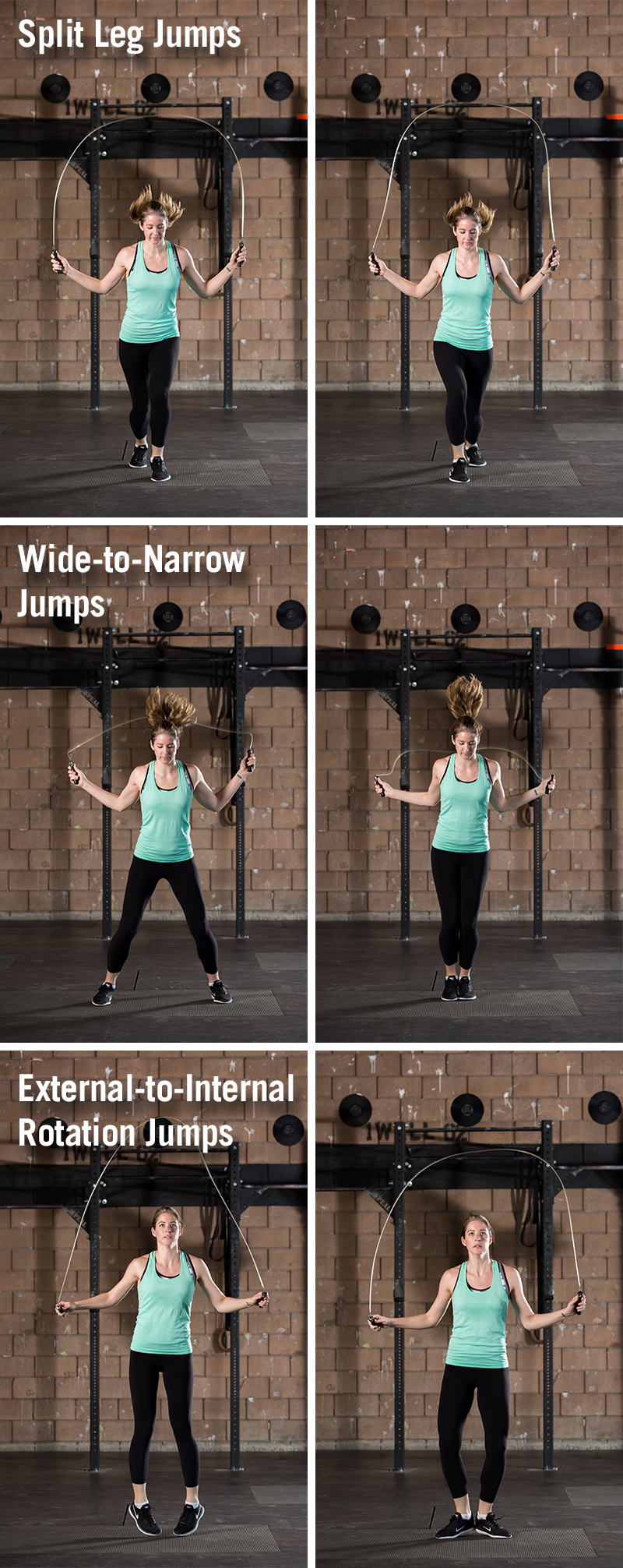
Perform multiplanar jumps by jumping in all three planes of motion. This helps prepare the muscles and connective tissue of your lower legs for the forces they experience during exercise. Perform eight to 10 jumps, rest for 30 seconds, and perform two sets for each plane.
Split Leg Jumps (Sagittal Plane):Start with your right foot forward and your left foot back. As you jump, move your left foot forward and your right foot backward before landing.
Wide to narrow jumps (frontal plane):Jump with your feet shoulder-width apart and then directly under your hips.
Rotation jumps from outside to inside (transverse plane):Jump up and rotate your right foot toward 2 o'clock and left foot toward 10 o'clock as you land. As you jump back, rotate your feet so they point at 12 o'clock. To protect your knees, do not rotate your feet too much and land with your knees slightly bent.
Train
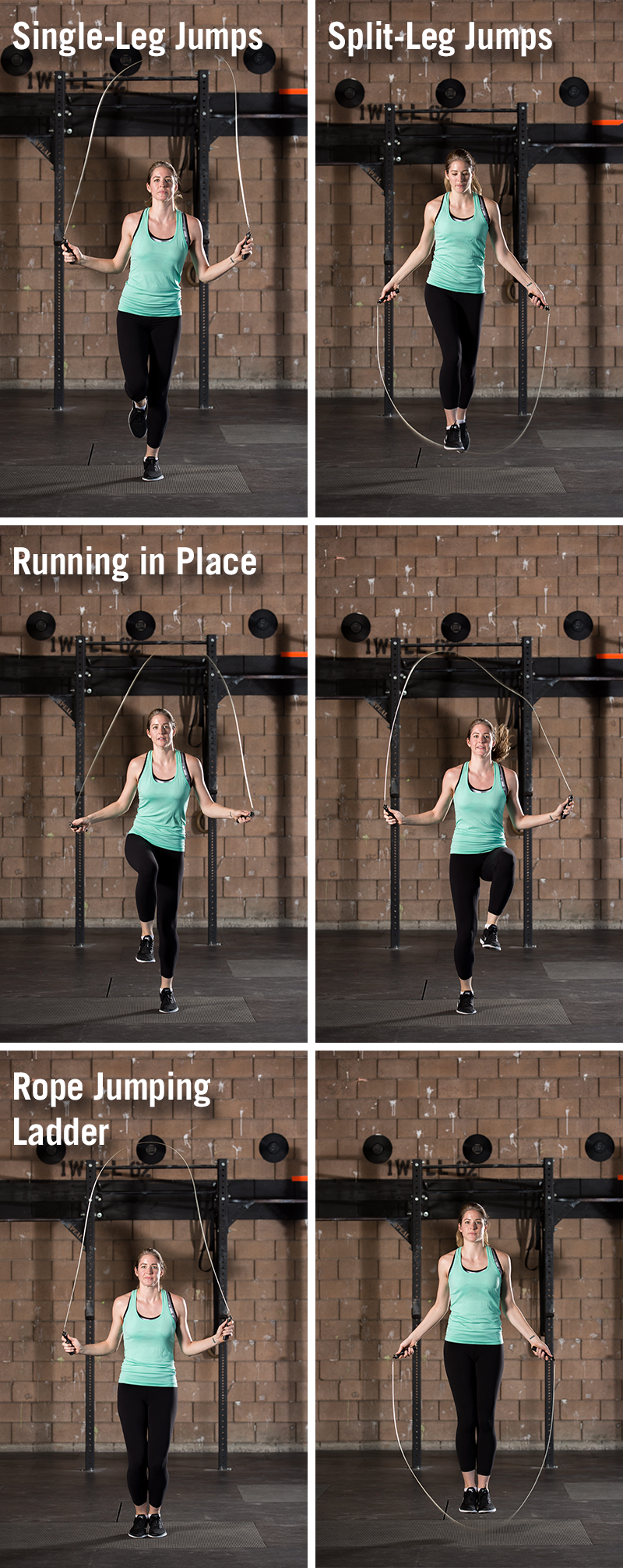
Single leg jumps:Set your timer for one minute and spend 30 seconds on each leg. Let rest for 15 to 30 seconds. (Note: Start with 30 seconds; shorten your rest time as your fitness improves.) Perform five minutes total (two and a half minutes per leg).)
Split Leg Jumps:Start with your right foot forward. While in the air, switch to your left foot forward and switch feet as you jump. Jump for a minute and then rest for 30 seconds. As you get fit, increase work time to 90 seconds and reduce rest time to 15 seconds. Perform four to six sets of time intervals.
Running in place:Alternate between right and left foot. Jump for 60 seconds and go to 90 seconds. Also, start your break at 30 seconds and reduce it to 15 seconds as your fitness improves. To increase intensity, perform 10-second intervals, alternating between fast and slow steps (10 seconds sprint, 10 seconds slow and steady). Perform four to six sets of time intervals.
Rope jump ladder:Use the traditional jump rope form, starting and landing on both feet. Start by jumping for 30 seconds and resting for 15 seconds. Add 15 seconds to each setting up to two minutes. Rest for 30 seconds and go back down the ladder to 30 seconds. If jump rope is your only workout that day, consider doing ladder workouts every 30 seconds for up to three or four minutes.
Cool
Calf stretch::Lean against a wall and place your right leg straight back. Keep your hands on the wall and press your right heel into the floor while keeping your knee fully extended. Hold for 30 to 45 seconds and perform two to three reps on each side.
Quadriceps stretch::Lie on your right side and hold the top of your left foot in your left hand with your left knee pointing straight toward your right leg. Hold for 30 seconds and then switch