

 Suche
Suche

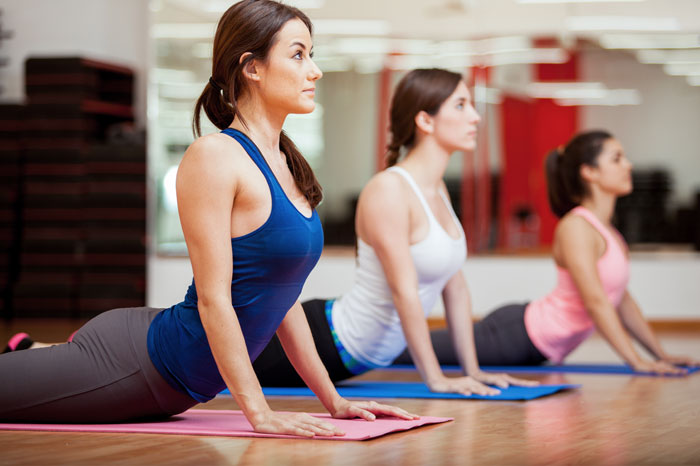
If you love group fitness classes, you probably already know some of the golden rules of being a good student, such as: B. Getting to class on time and putting your equipment away when you're done. However, there are some additional considerations that can help you maximize your results. Four of the country's top group fitness instructors share the mistakes students commonly make in various group fitness classes and offer tips to help you get more out of your next sweat session.
Aquatic fitness
The error: Going in too deep
One of the great benefits of a flat water aquatic fitness class is a joint-friendly fitness experience. However, positioning your body too low in the water can result in a less effective workout, shares Stephanie Thielen, certified aquatic instructor and exercise specialist, with the Aquatic Exercise Association. "It is very common to see participants in the water at shoulder depth. A body submerged at the waist is supporting approximately 50 percent of its body weight, while a body submerged at the chest is supporting approximately 25 to 35 percent of its body weight." The downside to performing exercises at shoulder depth is that the body cannot maintain vertical alignment, meaning the strength-based benefits gradually diminish.
The repair:Thielen recommends positioning yourself in waist- to chest-deep water to maximize effectiveness. “This will help ensure you have control and strength to perform exercises at a moderate pace and not take over the buoyant properties of water, allowing you to experience the muscle strength benefits that water exercise classes provide.”
yoga
The error: Waiting for instructions to become mindful
With a variety of research-backed physiological and psychological benefits of mind-body exercise formats like yoga, it's clear that there's a lot to be gained from a class experience. However, don't wait for an invitation from the teacher to become more attentive or rely on mirrors to see where you are Lawrence Biscontini, mindful movement specialist and award-winning international fitness educator based in Mykonos, Greece.
The repair: To spend more time on your mat, Biscontini recommends practicing closing your eyes at will throughout your yoga practice to strengthen your own kinesthetic sense without having to wait for instructions. “This improves balance, helps you “work,” and overall increases your self-awareness about time and space. This allows you to know where you are by feeling where you are instead of seeing where you are. This is one of the true goals of mindful disciplines. “
CrossFit
The error: Assume the only warm-up approach is the one provided by the instructor
Just as there is no one-size-fits-all approach to training, there is also no perfect warm-up for all students, especially when it comes to CrossFit. Sabrena Merrill, ACE master trainer and CrossFit instructor in Kansas City, Missouri, says it's important for individuals to spend time meeting their own personal needs. To address everyone's needs in a warm-up, some participants may need to pay attention and spend more time mobilizing one area than intended. In these cases, I would like participants to not always do exactly what I say during the warm-up, but instead to modify the warm-up and spend time addressing their individual needs. “
The repair: Don't feel obligated to follow the coach's warm-up closely. Instead, Merrill recommends respecting your uniqueness and approaching the warm-up—and the entire WOD—accordingly, as this will help ensure a safe and effective CrossFit experience. "For example, someone with stiff ankles may need to spend more time foam rolling and stretching their calves. If that means the participant spends less time on the other mobility exercises programmed in the warm-up, then so be it."
Indoor cycling
The error: Pedaling too fast without sufficient resistance
One of the most common mistakes people make in the saddle is pedaling too fast with little to no resistance. Many people choose to ride without resistance because they mistakenly believe that too much resistance leads to big, bulky legs, which is completely false, according to Keli Roberts, Schwinn indoor cycling champion and competitive cyclist. "Riding with sufficient resistance results in greater performance. Because performance most closely matches calorie burn, adding resistance can help your legs become smaller, stronger, and clearer."
The repair: To maximize the benefits of this class format, Roberts recommends pedaling with appropriate resistance between 70 and 100 rpm (revolutions per minute). This corresponds to the number of times one of your legs completes a complete pedal cycle per minute. “By using appropriate resistance, you increase power,” explains Roberts, “which means you burn more total calories.”