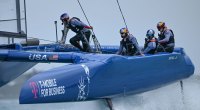
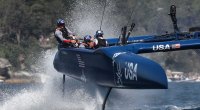
Success at SailGP depends on teamwork and communication. As a one-design class, all 10 teams use the same equipment for each race and have access to each other's team data. Capable of reaching speeds of up to 60 miles per hour, the F50 catamaran is designed to put performance and results directly into the hands of the elite athletes on board like Jimmy Spithill. As skipper of the United States SailGP Team, Jimmy Spithill is responsible for knowing the logistics of the event in case the start and end point will change, communicating with his crew on board and making the decision about it.
Success at SailGP depends on teamwork and communication. As a one-design class, all 10 teams use the same equipment for each race and have access to each other's team data. Capable of reaching speeds of up to 60 miles per hour, the F50 catamaran is designed to put performance and results directly into the hands of the elite athletes on board like Jimmy Spithill. As skipper of the United States SailGP Team, Jimmy Spithill is responsible for knowing the logistics of the event in case the start and end point will change, communicating with his crew on board and making the decision about it.
SailGP Jimmy Spithill strength and HIIT session routine
Success at SailGP depends on teamwork and communication. As a one-design class, all 10 teams use the same equipment for each race and have access to each other's team data. Capable of reaching speeds of up to 60 miles per hour, the F50 catamaran is designed to put performance and results directly into the hands of the elite athletes on board like Jimmy Spithill.
As skipper of the United States SailGP Team, Jimmy Spithill is responsible for knowing the logistics of the event in case the start and end points will change, communicating with his crew on board and making the decision about where to go on the racecourse. Spithill's training, while easy to explain, is anything but. Craig McFarlane, sports director of the US SailGP team is tasked with ensuring that every member of the team is at their best on race day.
Below is exactly what one of Spithill's sessions entails. Also, don't forget to hydrate, he says.
Mit freundlicher Genehmigung von SailGP
Jimmy Spithill's SailGP Strength & HIIT Session Flow
Mobilität & Aktivierung (10 Min.)
Beweglichkeits- und Reaktionsübungen (10 Min.)
Strukturfestigkeit (15 Min.)
HIIT / MetCon (20-30 Min.)
Erholung (5-10 Min.)
Mobility + activation session
US SailGP Team Athletic Performance Director Craig McFarlane says the key concept here is to prepare Jimmy Spithill for the movements and muscle groups he will use in the session, especially at the start.
mobility
Wirbelsäule: MacFarlane konzentriert sich auf die Mobilität der Wirbelsäule in allen Bereichen: Flexion, Extension und Rotation. Das löst viele muskuläre Verspannungen und schafft mehr Geschmeidigkeit des Bewegungsapparates.
Hüften: Jeden Tag werden verschiedene Hüftöffner und vom Yoga abgeleitete Posen ausgeführt. Die Hüftregion ist die treibende Kraft für jede Sportart und das Kraft- und Stabilitätszentrum. Jimmy hat, wie die meisten Fahrer auf einem F50, enge Hüften – sowohl hinten als auch vorne – aufgrund des ständigen Stehens und Stabilisierens in einer so dynamischen und aggressiven Umgebung, damit die oberen Gliedmaßen ungehindert globale Bewegungen (Lenken) und feinere komplexe sensorische Bewegungen ausführen können ( Tastenfunktion am Lenkrad).
Schultern: Die Aufrechterhaltung der Schultermobilität und -flexibilität ist sehr verletzungspräventiv und mildert jede nach unten gerichtete Tendinopathie, die Fahrer mit ihren Ellbogen/Unterarmen aufgrund des ständigen Greifens am Lenkrad erfahren können.
activation
There's a bias towards the posterior chain - we're talking glutes, hamstrings, lower back. Spithill's sailing position involves standing. This is the position he lives in on the F50, so we need to make the activation movements and exercises translatable.
Flexibility and reaction exercises
Some cognitive qualities that the F50 drivers need to work on are: focus, concentration, reaction time and footwork.
"I like to wake up the nervous system and higher function perception earlier in the session. I will use various close-range reactive mobility exercises, using all sensory elements such as sight, hearing and touch.
I start with a combination of jump rope work and a band-resisted fast-leg turnover drill. I'll loop a resistance band around the waist, and I'll provide an anchor and resistance from behind. The athlete sprints in place for a maximum of five seconds, then lightly jogs for five seconds, three times for two laps. These low-resistance leg turnover exercises help all F50 athletes cross the platform more consciously and quickly between maneuvers to perform their position sailing function more quickly.
Then there will be Footwork and flexibility exercises in which he responds to a request for multiple sensory training - starting with a visual cue and then with multiple verbal responses throughout the exercise or task. These exercises are becoming increasingly complex.
Courtesy of SailGP
Structural strength
Strength is so much about Injury prevention and building physical resilience. A driver like Spithill gets thrown around just like the grinders on the F50. Strength equals stability equals performance!
There is a large focus on asymmetrical and midline core strength training that challenges all structural systems. The strength component includes a key lower body movement with a complementary lower body exercise for three to four sets with a short rest.
MacFarlane will utilize “dead time” during the rest period between sets and incorporate injury prevention measures specific to the needs of the athlete or position. Shoulder stability and rotator cuff strengthening are a must for riders.
1a.Single-leg kettlebell deadlift key move This helps:
Hintere Kette: Gesäßmuskeln, Kniesehnen, Rücken.
Hintere Schlingen: Faszien, die von und diagonal nach unten verlaufen und das Skelettsystem stabil halten, wenn es nicht ausbalanciert ist.
Kern
Stabilität
1b. Single scale with side wall ball ejection This helps:
Co-Kontraktion
Gleichgewicht
Hand-Auge-Koordination
Kern
I will follow the lower body couplet with a short upper body strength couplet that will have push + pull. To receive maximum benefit and incentive, it is important that drivers also lift heavy and challenging loads.
This upper will consist of three shorter sets with very short rests (around 60 seconds) between sets:
2a. Single-arm standing cable or band press: Do six reps heavy. This helps:
Hohes Gewicht wird alle strukturellen Systeme herausfordern
Das Stehen greift in den Kern ein, um stabil und quadratisch zu bleiben und Rotationskräfte zu vermeiden
Fähigkeit, von den Hüften abwärts zu verankern und zu stabilisieren, während sich das Obermaterial unter stark belasteter Belastung dynamisch bewegt. Eine extreme Simulation von F50-Stress
Schubkraft
Verspannung
2b. One-arm kettlebell bentover row (unassisted): Heavy for 8 reps. This helps:
Rückenstärke.
Hintere Kette unter einer isometrischen (nicht beweglichen) Belastung.
Kern
Stabilität
Standing in a stable hinged position with a wide, stable base, pull the kettlebell to the side of your torso and keep your elbow high and close to your side.
Remember to take advantage of “dead time” during the rest period between sets. This is also good for low level physical training. Most drivers like that work on grip strength or finer grip strength. So different ways of carrying that challenge the grip.
Mit freundlicher Genehmigung von SailGP
Cardio block – HIIT/MetCon
These cardio blocks are very metabolically dense – which involves high energy expenditure and targets multiple energy capacities, abilities and sensory elements.
For any SailGP F50 rider, boxing would be one of the biggest bangs for your cardio buck. When you look at the F50 crossover advantages, you can understand why Jimmy Spithill not only embraced this art but took it to another level.
Drivers must work on:
Fokus
Konzentration
Reaktionszeit
The Boxing builds skill and technique work Get your hips and feet moving, cover all punch variations and evasive techniques. Skill complexity will progress quickly as you have to memorize multiple punch and move combinations while avoiding getting hit with the pads. All combinations challenge focus, concentration and reaction time. Then only when the complexity settles into the magic is added - breathing and heart rate are affected. This is done by integrating shuttle work, boat weight, core exercises, and layering sensory response training, similar to earlier in the session.
This cardio block will wave blocks of intensity with very short recovery periods. During recovery periods Jimmy will do it Focus on breath work and breathing techniques to quickly lower his heart rate, exit the flight, or shift the sympathetic state to a more relaxed parasympathetic state. This is a technique he uses on the F50.
Restoration
That's three to five minutes very Low intensity cardio or walking, followed by stretching for key areas of the body.
Keep the stretch block very simple – three key stretches and then hold each for two to four minutes!!
Couch Stretch: Dies trifft die vorderen Hüften, Quads.
Halb sitzender Grätsche: Wir machen dies für die Kniesehnen, Adduktoren, den unteren Rücken.
Bankdehnung: Dies bearbeitet den Rücken und die Schultern.


 Suche
Suche