

 Suche
Suche
How to Do a HIIT Elliptical Workout (Plus, 2 to Try)
What do you get when you cross a treadmill with a bike? An elliptical trainer, that awkward machine that seems simple until you try to coordinate your push and pull. While the elliptical trainer is a gym floor staple and a solid cardio option, it's probably not the first piece of equipment you think of when it comes to high-intensity interval training (HIIT). But what makes the elliptical trainer a good cardio machine also makes it great for HIIT workouts – if you do them right. Here's how. The Benefits of Elliptical HIIT Workouts One of the main benefits of the elliptical trainer is that it is very low impact and...

How to Do a HIIT Elliptical Workout (Plus, 2 to Try)
What do you get when you cross a treadmill with a bike? An elliptical trainer, that awkward machine that seems simple until you try to coordinate your push and pull. While the elliptical trainer is a gym floor staple and a solid cardio option, it's probably not the first piece of equipment you think of when it comes to high-intensity interval training (HIIT).
But what makes the elliptical trainer a good cardio machine also makes it great for HIIT workouts – if you do them right. Here's how.
The benefits of elliptical HIIT workouts
One of the main advantages of the elliptical trainer is that it is very low-impact and weight-bearing. That's a huge plus "for people who have limitations that don't allow them to run or do a high-impact HIIT workout," says Jonathan Higashi, a NASM-certified personal trainer at Life Time Laguna Niguel in California.
But cardio queens who simply need a break from the repetitive effects of running or hundreds of burpee and squat jump reps can also swap in the machine without sacrificing the cardiovascular benefits. The beauty of the elliptical trainer is that you can adjust the resistance and incline to efficiently reach your peak intensities and maximize your workout, says Higashi. (
You don't have to do cardio to lose weight - but there's a catch
A 2010 study found that you can burn the same amount of calories, use the same amount of oxygen (a measure of cardiovascular work), and increase your heart rate to the same rate whether you're on the elliptical or treadmill. (
Which is better: elliptical trainer or treadmill?
Plus, the elliptical trainer works your arms in a way that a stationary bike or stepper doesn't, making it a full-body workout. Using the machine's arms, "you can selectively shift your focus to using your upper body—including your arms, shoulders, chest, and back—to move the elliptical," says Erika Lee Sperl, a kinesiologist and certified performance improvement specialist in Minneapolis, Minnesota. Calling on more muscles can increase the overall intensity of the HIIT elliptical workout. (By the way, the rowing machine is also a great option for low-impact, full-body cardio.)
The Disadvantages of Elliptical HIIT Workouts
There are a few downsides to HAM on this machine - and not just the embarrassment that happens when you can't get the machine and your body together properly.
“One of the downsides of a HIIT elliptical workout is that you lose the potential benefits of your body having to adapt and respond to the impact being placed on your muscles and joints,” says Higashi. The impact is important because it puts more stress on the ankles, knees, hips and pelvis, as well as the bones that connect them, says Sperl. “When done correctly, with good form, and in moderation, some level of impact on bone health is critical,” she explains.
You also move on the elliptical trainer in a single plane of motion, similar to running. “We tend to do a lot – both in our daily lives and in shared exercises – in the sagittal plane (front-to-back movement),” says Sperl. “Training in multiple planes of motion – such as frontal (left-to-right movement) and transverse (including rotational movements) – helps round out your body’s strength and ward off injury.”
How to Design a HIIT Elliptical Workout
Quick refresher: A HIIT workout consists of short periods of intense exercise followed by less intense recovery periods. “Intensity” can be measured by speed, power, heart rate, and other variables, but one of the easiest ways to measure it is to rate your rate of perceived exertion (RPE) on a scale of 1 (very easy/little to low effort) to 10 (extremely difficult/maximal effort), says Higashi. During your short work hours, you should train at an RPE of nine or ten. (Not ready to go that hard? Consider this elliptical workout for beginners instead.)
Warm up:As with any other workout, a warm-up is crucial - especially because you're about to put in your full effort. “Your warm-up should last between eight and 12 minutes and consist of a gradual increase in intensity, so that by the end of your warm-up your RPE should reach seven out of ten,” says Higashi. This means you could have a conversation (but probably wouldn't) and probably worked up a sweat. "This helps increase your body temperature, blood flow, and fat utilization, which helps you train longer and harder," explains Higashi. Follow your warm-up with a two to five minute recovery period to prepare your body for the actual workout.
Length:When it comes to the length of your HIIT workout, at least 10 minutes (without warming up!) can be effective, says Sperl. “This can be divided into intervals of up to four minutes and those of five to ten seconds,” adds Higashi. (
What is the difference between HIIT and Tabata?
Intervals:When it comes to intervals, a good starting point is a 1:1 work-to-rest ratio - that is, 30 seconds of work followed by 30 seconds of rest. Depending on your fitness level, you may want to adjust this ratio. "If you're a beginner, you may need to either decrease work and increase rest times to create a 1:2 ratio (i.e. 30 seconds of work followed by a minute of rest)," says Higashi. "If you want to challenge yourself, you can choose to do more work with fewer breaks (i.e. one minute of work with 30 seconds of rest)." (Keep all of this in mind if you're bringing your HIIT workouts to the treadmill or track, too.)
Recreation:And don’t skip or shorten your recovery periods! “If you're really pushing it and hitting a 9-10 RPE during your work intervals, dial it down to 6-7 (or even lower) during the off segments,” says Sperl. This gives your heart rate time to drop and your body to eliminate the byproducts of metabolism - carbon dioxide and lactate - so you can get right back to the high intensity you just crushed.
Elliptical HIIT workouts to try
Are you ready to try an elliptical HIIT workout? Try one of the two routines below or use them as a framework to design your own elliptical HIIT workout. Best of all, because they're based on RPE (and not incline or resistance level), you can easily transfer these HIIT workouts to other cardio machines like rowers or treadmills.
35 minute elliptical HIIT workout

You can adjust the incline and resistance as needed to achieve your desired RPE from 1-10 (where 10 is maximum effort).
- Aufwärmen (10 Minuten):
- 2 Minuten: RPE von 3
- 2 Minuten: RPE von 4
- 2 Minuten: RPE von 5
- 2 Minuten: RPE von 6
- 2 Minuten: RPE von 7
- Erholung: 5 Minuten, RPE von 3-4
- HIIT Workout (20 Minuten, Belastungs-/Erholungsverhältnis 1:1):
- 1 Minute: RPE von 9-10 von 10
- 1 Minute (Erholung): RPE von 3-4 von 10
- 10 Mal wiederholen
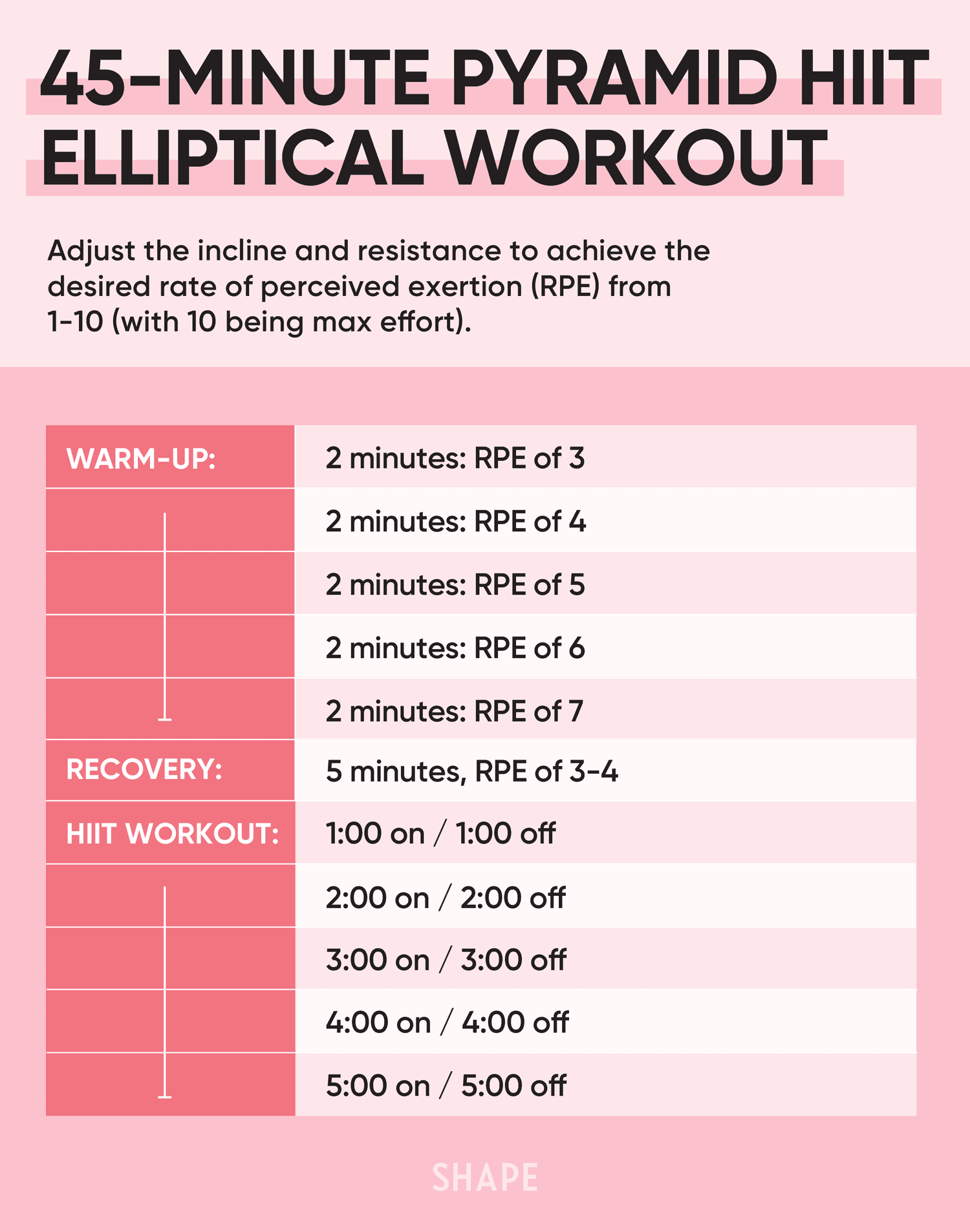
45 Minute Pyramid Elliptical HIIT Workout
Caitlin-Marie Bergmann Ong
By playing with the timing of the intervals, you're still working at a 1:1 work-to-rest ratio, but challenging your body to stay "on" for longer periods to build your endurance.
- Aufwärmen (10 Minuten):
- 2 Minuten: RPE von 3
- 2 Minuten: RPE von 4
- 2 Minuten: RPE von 5
- 2 Minuten: RPE von 6
- 2 Minuten: RPE von 7
- Erholung: 5 Minuten, RPE von 3-4
- HIIT-Training (30 Minuten):
- 1:00 ein / 1:00 aus
- 2:00 ein / 2:00 aus
- 3:00 an / 3:00 aus
- 4:00 an / 4:00 aus
- 5:00 an / 5:00 aus