

 Suche
Suche

The tallest and most muscular people in the world have one thing in common.
It's not great genetics.
(Good genes help, but many people grow huge without being blessed with it at birth.)
It's not like they all just live in the gym and do nothing else or follow some magical workout. (When it comes to building muscle, many different approaches can work – low rep/high weight, high rep/low weight, straight sets, supersets, and so on. There is no one “best.”)
And it's not like they're taking performance-enhancing drugs. (You can build a lot of muscle naturally—look no further than a drug-free bodybuilding competition for proof.)
What they all have in common is:
The patience.

Not the answer you expected? That's why it's so important to be patient.
The problem with bulking and cutting
First, when most people want to build muscle, they go through a phase where they eat a lot and exercise a lot. You've probably heard it called "bulking."
Then, after a few weeks or months, they change. Maybe they will become aware of the greatness they have gained. Or maybe they think they're starting to look fat. So they reduce their calories and change their workouts to try to burn off the fat. This phase is called “cutting”.
Most people bounce back and forth between these two phases – bulking and cutting, bulking and cutting – without making any real progress. Why? Because each new phase destroys the success of the last one.
We talked about set point theory on our website. It's the idea that the body identifies with a certain weight and then becomes resistant to change. In our previous article we discussed how it is applied to weight loss. This is one of the reasons why it can be so hard to lose weight - and keep it off.
But the concept also applies toMuscle gain. Your body is used to being a certain weight. Changing this through strength training will take action to return to what it was - unless you teach it that this muscle weight is greaterisit's new normal.
Let a Born Fitness trainer accompany you!
You teach your body this through what is called a maintenance phase. In a lecture on his website Renaissance periodization Dr. Mike Israetel discusses how people hold themselves back when they do thisnotInclude this phase in your training. (The content itself is paid, but it's worth purchasing if you want to delve into the science of building muscle.)
I don't want to give too much away or belabor the quality and depth of his explanation. So I'll summarize it like this: During a maintenance period, you make training a little easier. And you want to follow what's called an isocaloric diet, which means you try to eat as many calories as you need, but no more.
Example of a muscle building macronutrient formula
This formula Adam's big ab experiment will help:
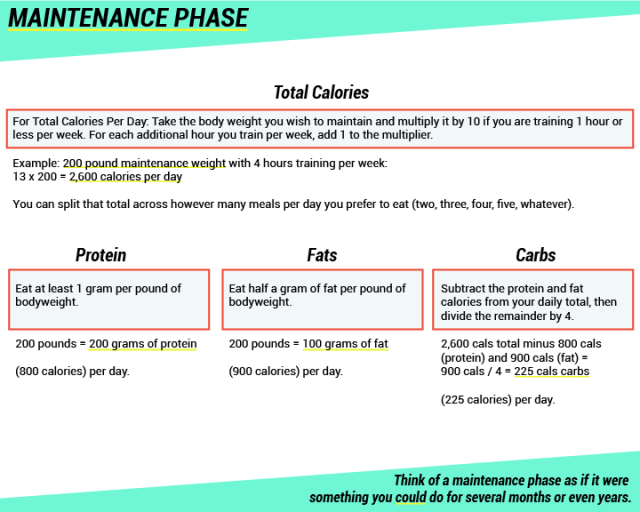
For total calories per day:
Take the body weight you want to maintain and multiply it by 10 if you exercise 1 hour or less per week. For each additional hour you train per week, add 1 to the multiplier. So if you gained up to 200 pounds of muscle and exercised 4 hours per week, you would multiply 13 by 200 and get 2,600 calories per day as a sign. You can divide this total into the number of meals per day you prefer (two, three, four, five, whatever).
Protein:
Eat at least 1 gram per pound of body weight. So if you were 200 pounds, you would aim for 200 grams of protein (800 calories total) per day.
Fat:
Eat half a gram of fat per pound of body weight. So at 200 pounds you would aim for 100 grams of fat (900 calories) per day.
Carbohydrates:
Determine how many carbohydrates you need to eat by subtracting the protein and fat calories from your daily total and then dividing the remainder by 4. Continuing the example used here, it would be a total of 2,600 calories minus 800 calories (protein) and 900 calories (fat), leaving you with 900 calories for carbohydrates. Divide that by 4 and you get 225 calories of carbohydrates per day.
While the length of your maintenance period may vary, you want to approach it as if it were youcoulddo for several months or even years. Why? Because – again – you want this to be your new normal.
You want to think about building muscle not in days and weeks, butmonths and years. The tallest, most muscular people in the world are the ones who show up to workout over and over again for years.
Topics of the next articles:
Building muscle at any age: Defying genetics and designing muscle building training
The New Specialization Rules: Adding Muscle Mass
How to Master the Art of “Old School” Muscle Building
5 Mistakes When Building Muscle (and How to Make Gains)