

 Suche
Suche
How to Do Skull Crushers, According to Trainers
You know when you're lying flat in bed on your phone, holding it over your face and your arms start to burn? Well, you're doing some sort of skull crusher. Here's everything you need to know about Skull Crushers, the triceps exercise that not only sounds badass, but makes you feel badass too. What are skull crushers? Skull crushers, also known as lying triceps extensions, are a movement traditionally performed while lying down on a bench or exercise mat using a pair of dumbbells or an EZ curl bar (just one of many barbells in the gym). You hold the weight with your elbows pointing upwards...

How to Do Skull Crushers, According to Trainers
You know when you're lying flat in bed on your phone, holding it over your face and your arms start to burn? Well, you're doing some sort of skull crusher.
Here's everything you need to know about Skull Crushers, the triceps exercise that not only sounds badass, but makes you feel badass too.
What are skull crushers?
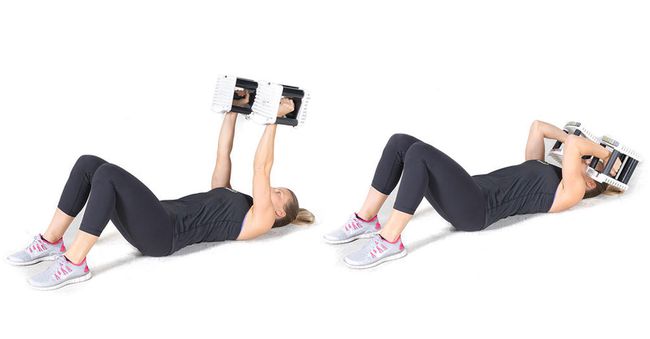
Skull crushers, also known as lying triceps extensions, are a movement traditionally performed while lying down on a bench or exercise mat using a pair of dumbbells or an EZ curl bar (just one of many barbells in the gym). You hold the weight above your face with your elbows pointing upward (hence the name "Skull Crusher"), then use your triceps (the muscles on the back of your upper arm) to extend your elbow and pull the weight toward the ceiling.
The benefits of Skull Crushers
By strengthening the triceps, Skull Crushers help make everyday functional movements easier.
They will help you with many other strength exercises.
"The triceps support your overall pushing power and are the primary extensor of the elbow joint," explains Riley O'Donnell, a NASM-certified personal trainer and instructor at Fhitting Room, a HIIT studio in New York City. "So if you're trying to get stronger at overhead presses, chest/bench presses, or push-ups, strengthening your triceps will help you achieve your goals."
You'll get better at push-ups.
Skull crushers improve pressing movements because they train your body to load weight with your elbows in a flexed position (a bent arm) and push the weight into an extended arm, says O'Donnell. "When we push things forward, we not only need to engage our shoulders, chest, and core, but we also need to be able to forcefully extend the elbow," she says. So if you struggle with push-ups, these are a great way to make them feel easier.
They target your triceps without any disruption.
Unlike other arm and upper body exercises, skull crushers make the triceps the primary muscle involved, allowing you to better target these smaller arm muscles. "The triceps rarely take the lead, compared to the biceps for lifting or holding or the glutes for walking or standing," says Ash Wilking, CFSC, FRC, Nike trainer and instructor at Rumble, a boxing gym. “This means they support larger muscle groups in countless movements, both in strength training and in everyday life,” says Wilking.
You can do them with limited mobility.
But by using only the elbow joint, skull crushers isolate the triceps, which isn't even true for many triceps-dominant exercises, says O'Donnell. "For example, standing triceps extensions and triceps dips require shoulder mobility that not everyone has," she says. For this reason, skull crushers are best for those who have limited range of motion in their shoulders and want to strengthen their triceps.
...Or an injury.
In addition to building triceps strength, skull crushers are beneficial for those who want a low-impact arm exercise or are working around an injury. "By lying on your back with the weight overhead, you focus primarily on the triceps and take pressure off other joints like your wrists (for push-ups) or lower back (for bent-over kickbacks)," explains Wilking.
You build grip strength.
Skull crushers also play a huge role in improving grip strength by preventing you from dropping the weight and literally crushing your head. "When performing skull crushers, whether with a pair of dumbbells, a barbell, or a plate, it's important to keep your wrists straight. It can be tempting to break your wrist during this movement because it feels easier to hold the weight, but focusing on keeping your wrists straight will improve your grip strength," says O'Donnell. (Need another lesson in grip strength? Try this battle rope workout.)
How to make skull crusher
There are two ways to do skull crushers: with a bench or an exercise mat. "Using a bench allows you to place your feet on the floor, which requires varying levels of engagement in your lower body and core; activating your glutes, tucking your pelvis, and keeping your core engaged and ribs down requires thoughtful effort," says Wilking. When you lie on a mat, your feet are also flat on the floor, but your knees are bent much more, allowing you to tilt your pelvis and create a better connection with your ribcage, she says. “This connection will limit shoulder movement and create true isolation of the triceps,” she says.
So if you're new to skull crushers, try doing it on a mat instead of the bench so you can move with more control and really engage the triceps during the eccentric (lowering) and concentric (lifting) phases of the movement, recommends Chris Pabon, a NASM-certified personal trainer and fitness manager at Blink Fitness. “You'll sacrifice some range of motion, but you'll learn good form,” he says.
To ensure you're performing Skull Crushers with proper form, O'Donnell also suggests practicing the movement using only your body weight and adding weight slowly. This means using a weight that is challenging but allows you to complete 10 to 12 reps with proper form. You can also use a dumbbell and grip it with both hands to start before trying a weight in each hand.
AHold a dumbbell in each hand and lie faceup on an exercise mat (or bench), knees bent and feet flat on the floor.
b.Extend your arms across your chest with your palms facing each other. Tighten your glutes and pull your chest down to prevent your lower back from arching.
CTuck your elbows in and press your shoulders down, slowly bending your elbows to lower the dumbbells about 1 inch above your forehead on either side of your head. Avoid moving the upper arms and anchoring the shoulders down to engage the lats and isolate the triceps as the weights lower.
DRaise your arms back up in a controlled manner.
Reject Skullcrusher
Pabon says that changing the incline on the bench can target certain heads (read: parts) of the triceps a little more than others. For example, when you use an incline bench (with your head lower than your feet), more activation is recruited from the lateral triceps head, which is toward the outside of your arm, says Pabon. Here's exactly how to decline skull crushers with a pair of dumbbells.
AHolding a dumbbell in each hand, lie faceup on a bench with your knees bent over the pillows and your shins locked in place.
b.Extend your arms across your chest with your palms facing each other. Tighten your glutes and pull your chest down to prevent your lower back from arching.
CTuck your elbows in and press your shoulders down, slowly bending your elbows to lower the dumbbells about 1 inch above your forehead on either side of your head. Avoid moving the upper arms and anchoring the shoulders down to engage the lats and isolate the triceps as the weights lower.
DRaise your arms back up in a controlled manner.
Incline Skull Crushers
Using a tilt (with your head at the top) works the long head of your triceps, which faces the inside of your arm, says Pabon. Here's how to do it.
AAdjust the bench to 30 degrees and lie faceup, holding a dumbbell in each hand and your feet flat on the floor.
b.Extend your arms across your chest with your palms facing each other. Push yourself back into the bench to prevent your lower back from arching.
CTuck your elbows in and press your shoulders down, slowly bending your elbows to lower the dumbbells behind your head.
DRaise your arms back up in a controlled manner.
Dumbbells vs. EZ Bar Skull Crushers
Whether you use a pair of dumbbells or an EZ curl bar, Pabon says the form is generally the same. With an EZ handlebar, you should make sure that your hands are just shoulder-width apart on the bar. Dumbbells are harder to control (since there are two of them), so you'll likely reduce your weight, while an EZ bar may allow you to lift heavier, but they can help address strength imbalances between your arms. If you have trouble locking your elbows, Pabon also says using an EZ bar instead of dumbbells can help resolve this issue.
Skull Crusher form errors – and how to fix them
Although skull crushers aren't complicated to master, they're a recipe for injury and pain if you don't execute them correctly. To help you get the most out of this triceps burner, here's a PSA on how to fix these easy-to-make mistakes. (Related: Beginner Exercises to Strengthen and Tone Your Arms)
1. Elbow flare-ups
As you lower the weights, it's tempting to extend your elbows outward to ease your triceps, but keeping your elbows inward ensures you maximize the burnout of these small but mighty muscles. "Imagine your elbows hugging a balloon to prevent your elbows from flaring and your upper arms against a wall throughout the movement," says O'Donnell. This helps keep your upper body in position on the mat or bench.
Wilking also recommends this visual cue: "Imagine grabbing a steering wheel and rotating your pinky fingers down and in to activate the lats."
Slowing down your movement can also help. "Control the weight in both directions - during the eccentric and concentric portions of the movement. Injuries usually happen during deceleration and/or rotation, so really focus on controlling that weight," says Pabon.
2. Shrugging of the shoulders
To really isolate the triceps and ensure you don't use your shoulders or upper arms, O'Donnell says to pack your shoulders down, also known as your lats. "If your lats are not engaged, there is a tendency to let your upper arm move during the skull crusher," explains O'Donnell. Tightening your core can also help stabilize the upper body, she says. "Because the skull crusher is performed on your back, your core works to keep the ribcage locked during the movement and press the lower back into the floor or bench," she says. Knitting the ribcage means pulling the ribcage down and together, activating the deep core muscles to prevent the lower back from compressing.
3. Arching of the lower back
This increases pressure on the lower back, which can lead to pain and injury. Wilking suggests pulling your chest down into the floor to avoid spreading it out. “Remember to press your feet into the floor as hard as you can and tighten your chest while pressing the backs of your ribs into the floor or bench,” says O’Donnell.
How to Add Skull Crushers to Your Workout
Ready to flex? Trying 3-4 sets of 10-12 reps is a good start. Wilking suggests doing skull crushers in a superset workout with a bicep exercise on arm days. She also recommends using it as an active recovery movement. "For example, if you're doing a leg or full-body workout, use skull crushers while allowing your legs to recover between sets," says Wilking. Pabon says he typically does skull crushers on days when he's focusing on other "pressure" muscles, like chest or shoulder day. “It's a great way to really finish them off [triceps] after using them as secondary muscles for the first part of the workout,” he says.