

 Suche
Suche

 If you're like most people, you've probably suffered from back pain at some point. According to the National Centers for Health Statistics, back pain is the leading cause of disability among Americans under 45. More than 26 million Americans between the ages of 20 and 64 suffer from frequent back pain and it is listed as the leading cause of chronic pain.
To stay off the list of common sufferers, it's important to first understand where this problem comes from so you can use some simple strategies to keep pain at bay.
As a human, you can walk around upright. To do this, you have a spine in the middle of your back that provides an anchor and focal point for almost every major joint in your body. It's not just a rigid bar that keeps you upright - it curves in a slight S-shape, accommodating the various bends, twists, and other movements you need to make every day.
However, the spine is not designed to hold its owneverythingfrom your twisting, bending and twisting alone. The joints that articulate with the spine, such as the hips and shoulders, are designed to work with the spine to accomplish this.
When we succumb to the desks, chairs, and couches of an inactive lifestyle, these joints that are supposed to work with the spine lose their range of motion. The muscles that help these joints move become immobile and weak. When these joints can no longer work effectively with the spine, the spine must take up the slack.
When the muscles that allow joints like shoulders and hips to move become weak and immobile, the spine must bend, extend, and rotate excessively to allow movement. This puts quite a lot of strain on the tissue between the spines. After a while, these tissues become agitated, inflamed, and injured. The result is chronic back pain and injuries.
An effective two-strike approach to alleviating some of these problems includes:
- Verbesserung der Bewegungsbereiche der Gelenke, die sich durch häufige und effiziente Beweglichkeitsübungen artikulieren
- Vermeiden Sie längere Sitzzeiten
Of course, as simple as the two-strike approach sounds, modern everyday life no longer facilitates frequent movements. We sit in cars to go to a job that requires us to sit at a desk. After a long day, we enjoy the idea of sitting in our favorite chair and watching TV. Our ancestors would be alarmed at the now “groundbreaking” lifestyle.
If this sounds familiar, it's time to create disruptions throughout the day to break up your sitting bouts and restore your back health. Set a timer to sound every 60 minutes. Stand up and perform one of the three stretches described below.
Note: If you suffer from chronic back pain, you should speak to your doctor.
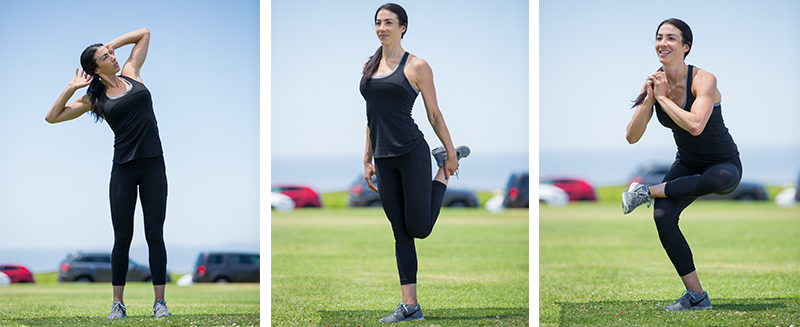
The standing rainbow lat stretch
The lat pulldown muscles are the large wing muscles of the back. They attach to the inside of the arm bone and extend the length of the back to the hips, which provide an important interface between muscles and other interconnected tissues. If you sit hunched over for a long time, the lat pulldown muscles shorten. Because it is such a large muscle, this causes some problems with posture, flexibility, and general mobility. This stretch helps bring the lat muscle back to the correct length so everything else can follow suit.
- Stellen Sie sich aufrecht hin, die Hände schulterbreit hinter Kopf und Füßen gefaltet.
- Lehnen Sie sich nach vorne, ohne sich nach vorne zu beugen, als stünde Ihr Rücken an einer Wand.
- Schau auf deinen rechten Ellbogen.
- Aufgrund der geringen Flexibilität beugen sich viele Menschen nach vorne und drehen sich leicht, fast so, als würden sie eine stehende „Crunch“ -Bewegung ausführen. Vermeiden Sie dies, indem Sie die Wirbelsäule so hoch wie möglich halten.
- Halten Sie die Dehnung 15 bis 30 Sekunden lang und wiederholen Sie dies auf der anderen Seite.
- Wiederholen Sie zweimal auf jeder Seite.
Standing Stork Stretch
The hip flexors are strong, commonly used muscles in standing upright and in movements such as walking, climbing, running, and being active. When you sit for long periods of time, these muscles become weak and short. The deepest of these muscles, the psoas, arises from the spine and attaches to the femur (the large leg bone). When this muscle becomes weak and short due to inactivity, the hips cannot move as they should. The lumbar spine takes up the slack and is forced to flex and remain frozen in positions that cause problems with the connective tissue between the vertebrae. Stretching the psoas muscle restores its natural length and function so it can do what it's supposed to do.
- Stellen Sie sich aufrecht hin und bringen Sie die Ferse des linken Fußes in Richtung der linken Gesäßmuskulatur.
- Nehmen Sie bei Bedarf einen Schreibtisch oder ein anderes stationäres Objekt zur Unterstützung.
- Fassen Sie mit der linken Hand die Oberseite des linken Fußes in der Nähe des Knöchels.
- Wenn Sie den Fuß nicht greifen können, wickeln Sie ihn mit einem Handtuch oder Band um den Fuß.
- Drücken Sie den linken Gesäßmuskel zusammen und stellen Sie sich so aufrecht wie möglich auf, während Sie das linke Knie mit dem rechten Knie in Einklang bringen.
- Schieben Sie die Hüften leicht nach vorne, während Sie die linke Ferse zum linken Gesäß bewegen.
- Behalten Sie die Beugung des linken Gesäßmuskels und die Spannung der nach vorne drückenden Hüften bei, um ein „Verbeugen“ des unteren Rückens zu verhindern.
- Halten Sie die Dehnung 15 bis 30 Sekunden lang und wechseln Sie dann die Seiten.
- Wiederholen Sie zweimal an jedem Bein.
The standing figure 4 stretch
The glutes are powerful hip extensors that allow you to walk around and stand upright. They also help your hips rotate in and out. When you are inactive, these muscles can become weak and stiff. In this case, hip extension and rotation is replaced by excessive spinal extension and rotation during movements such as standing, walking, running, or other physical tasks. Stretching the hip rotators (the glute muscles) allows them to function through their natural range of motion so that the spine doesn't have to accommodate the tab.
- Stellen Sie sich aufrecht hin, beugen Sie das rechte Knie und platzieren Sie die Außenseite des rechten Knöchels direkt über dem linken Knie.
- Legen Sie die Hände zur Unterstützung auf ein stationäres Objekt, falls erforderlich.
- Halten Sie die Hüften nach vorne und die Wirbelsäule hoch (halten Sie die Brust hoch) und beugen Sie das linke Knie langsam, während Sie die Hüften nach hinten drücken.
- Beugen Sie das Knie weiter und halten Sie dabei die Hüften nach vorne und die Wirbelsäule hoch, bis im rechten Gesäßbereich eine erhebliche Dehnung zu spüren ist.
- Halten Sie diese Position für 15-30 Sekunden.
- Wiederholen Sie zweimal an jedem Bein.
Set a timer and move strategically throughout the day with these three stretches to avoid becoming a back pain statistic.