

 Suche
Suche
Jimmy Spithill Strength Training for High Speed Sailing
Jimmy Spithill won his first sailing race at the age of 10. In the three decades that have passed from that moment, he has accumulated various other victories and is one of the most decorated sailors in the world. Now the Australian is looking to add to his stellar resume as skipper of the United States SailGP team. In its third season, the racing league includes 10 national teams from around the world and is considered F1 on the water. Teams travel aboard a 50-foot hydrofoil sailing catamaran designed for intense racing and capable of reaching 60. Jimmy Spithill came on in the second...

Jimmy Spithill Strength Training for High Speed Sailing
Jimmy Spithill won his first sailing race at the age of 10. In the three decades that have passed from that moment, he has accumulated various other victories and is one of the most decorated sailors in the world. Now the Australian is looking to add to his outstanding CV as skipper of the United States SailGP Team.
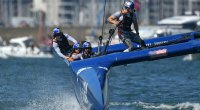
In its third season, the racing league includes 10 national teams from around the world and is considered F1 on the water. Teams travel aboard a 50-foot hydrofoil sailing catamaran designed for intense racing and capable of reaching 60.
Jimmy Spithill joined the US team in the second season and helped lead the crew within reach of the top prize after they finished last in the previous season. It was a big step for the new side, but the veteran knows it will require a lot more work if they are to continue to challenge the Australian team, which Spithill sees as the benchmark in the league and last season's winners.
Muscle and fitnessspoke to Jimmy Spithill about how sailing has changed and what it takes to be successful on the F50 foiling catamarans.

Jimmy Spithill is not your grandfather's sailing league
I think when people originally think of sailing they probably think of jumping on a crashing yacht, grabbing a gin and tonic and sitting back in a chair. It's completely different now with the physical demands, the decisions, how quickly they have to be made and the consequences if you get it wrong, how serious it can be.
The stuff we're going through now is spot on what motorsport is going through in terms of safety and collisions, the equipment the guys wear and the training you have to go through. The most important part today is that you can leave no stone unturned. You look for every competitive advantage you can get. If you look at all the individual guys on the teams, they're all great athletes and they all have a range of skills. Ultimately, with this style of racing you just want to be as consistent as possible. You can't race at such a high level with the data available if everyone is on the same boat and doesn't make mistakes. You really have to try to average it out. You have to be consistent, and if you can get on the podium, then you're kind of going all out. It's definitely a stressful environment.
When I started, there was no foiling – certainly in terms of technology. The tools you had for analysis and debriefing were rather rudimentary. Now if you look at the boats, they can reach four times the speed of the wind and literally fly over the water. While it's a good problem to have, you also have so much data that there's too much. Part of the art is really focusing on the right areas to extract the key information. The other big change in my career is the fact that now you can have the best people in the world on the same equipment, but you can see everyone's data, and they can see ours. We are all recorded live on microphones during the race, there are cameras strapped to the boat and there is no hiding. It's a fascinating thing because what it produces is very good racing. It's an amazing thing to be a part of. With all of that, you push each other so much that the learning and the level you reach is definitely the highest I've ever seen.
Jimmy Spithill feels unwell during training
Everyone trains a little differently depending on their role on the boat. What I personally like to train are things that pushes me a little to the point of exhaustion or put pressure on myself and then I have to decide. I have always enjoyed a number of things that make me uncomfortable and put me in a stressful situation.
That's why I still box a lot because of hand-eye coordination. I don't do sparring anymore, but a lot of the pads and getting to that point of exhaustion is what I focus on, just staying sharp, because ultimately, out on the track, there's going to be a lot of times where you're going to be stressed, and you're going to have to make split-second decisions, and you're going to have to do it together. The more you can put yourself in situations where you have to make decisions when you're stressed and exhausted during training, the better prepared you'll be when the moments come.
I've definitely tried different things. You have to have variety and try new things. To grow, you have to be open-minded. At the same time, one of the great things about technology is that there is always something new or different. For example, we're pretty lucky in the US team where we have Red Bull as one of our sponsors. They have a huge high performance department that is part of their company. When you look at the stable of athletes they have in all the different sports, the ability to connect with the other athletes on the roster, the ability to spend time with the high performance teams, the mental side of it understand how the brain works, especially when you make mistakes – it's remarkable. The most important thing is really the culture within the team. You really have to have a culture where everyone is really willing to let their guard down and put their ego aside and ask the questions, what can I do better and what will help the team? We worked pretty hard on that with the US team.

Jimmy Spithill trains smarter after 40
I'm in my early 40s now, and when you're younger you can pretty much go full throttle all the time and not have to worry too much about what you're putting into your body. In 2013 I started getting a lot of injuries and I was doing a lot of different sports. I did CrossFit competitions, boxing, paddleboard racing and long distance stuff. A surgeon friend of mine advised me to get checked out. I went and got tested to understand what my body was reacting to. I found out that my body can't handle a lot of things. It was never really enough to stop me, but there were things that just didn't sit well with me. One thing was sugar and the others were dairy, gluten and whey protein. At that time it was instilled in me that after a hard training the best for recovery was a whey protein shake. For me, that was probably the worst thing you could do because a lot of these things caused inflammation in my body, which affected my recovery and sleep. If you put crappy gas in a car, it won't run as well. After eliminating these, the gains were amazing and exactly what I was able to achieve with this diet change.
A good night's sleep is hard to come by
It's definitely a struggle and I travel a lot. I race and work in different parts of the world. I'll be in Australia, then back in California, then Europe and we have a global route. All the teams experience coming to a place that could be after a long flight, and they're only there for four days, and they have to perform and get out. Without a doubt, the sleep cycle is a struggle, but if you learn and understand some of these hacks that work well, it all adds up. It reminds me of when you're training for a sport and you're trying to add up all the little things. It can make a pretty big difference on the track, and the same goes for your sleep and recovery routine. All those little things, the diet, the rest, the stretching and going to the sauna and ice baths, it all goes into performance. The more rested you are, the better decisions you will make and you will be able to process things much faster. One of the joys for me is that what we do is really hard. Everyone has the same challenges and that's what makes winning so rewarding. You all push each other and you also grow as you go through this.
Not much time to practice
In SailGP I think it's a bit like Formula 1 where there is a real restriction on training. The boats basically come in, you get two days of training, you race on the weekends and then they get packed. So like in Formula 1, when the boats aren't racing, they go to the next venue. That alone makes it challenging for a new team that we are. Some of us have never raced together before and you are competing against teams that have been sailing together as a unit for years. I think we have a fantastic group. The Australians are probably the best example because they have spent the most time racing and sailing over the years. But with the right approach, work ethic, support, staff and coaching, and a thorough review of the data, you can make really good profits. That's certainly what we'll focus on this season.
.
Source: muscleandfitness