

 Suche
Suche
How to Train for a Half Marathon for Beginners (Plus 12-Week Plan)
The half marathon may very well be the perfect race. Thirteen point one miles is a distance that is hard enough, requires commitment and training, but is accessible enough that anyone can do it - with the right plan! — without training determining your entire life. That's likely why half marathons have the most participants, with 2.1 million people competing worldwide in 2018 alone, according to data from RunRepeat and the International Association of Athletics Federations. You're thinking about signing up for a race, but you have no idea how to register for one...

How to Train for a Half Marathon for Beginners (Plus 12-Week Plan)
The half marathon may very well be the perfect race. Thirteen point one miles is a distance that is hard enough, requires commitment and training, but is accessible enough that anyone can do it - with the right plan! — without training determining your entire life. That's likely why half marathons have the most participants, with 2.1 million people competing worldwide in 2018 alone, according to data from RunRepeat and the International Association of Athletics Federations.
Thinking about signing up for a race but have no idea how to train for a half marathon? Turn to this 12-week training plan, developed by Nike+ Run Coach Jes Woods, designed for beginner half marathoners who currently run three or four times per week and average 10 or more miles per week.
That's a pretty standard level of running fitness - imagine being able to run for 30 minutes straight three or four times a week. During this beginner's half marathon training plan, you'll gradually work up to running five days a week as you build your endurance, strength, and speed - everything you need to make 13.1 feel easy. (If you're not quite there yet, check out our Couch to Half Marathon training plan instead.)
Ready to run? Below is the saveable and printable half marathon training plan for beginners. But first, read Woods' breakdown of all the important parts of how to train for a half marathon.
How to train for a half marathon
Understand tempo setting
First things first about this “How to Train for a Half Marathon” guide: Understand that your pace isn’t just about hitting a specific goal time. During your half marathon training, you'll run at different speeds to train different aspects of your fitness. (Related: Is it better to run faster or longer?)
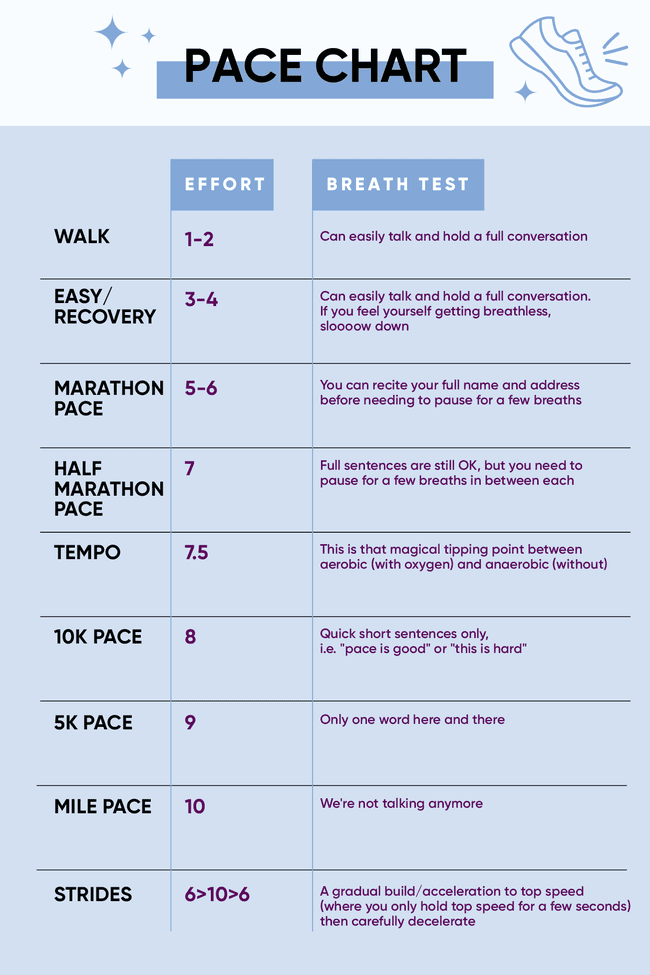
Think of the pace in terms of effort on a scale of 1 to 10: an easy run should feel like an effort level of 3 or 4, as if you could hold a full conversation without getting out of breath at all; Your half marathon pace should feel like a 7, like you can still blurt out a full sentence but catch your breath afterwards; Your 5K pace is a 9 out of 10 effort level, and you should only be able to manage a word here and there. Use this pace chart to identify your pace as you complete the workouts in the Beginner Half Marathon Training Plan below.
Caitlin-Marie Bergmann Ong
Combine speed runs and hill training
To become fast, you have to run fast. So on speed days you'll be working on your top speeds - your 5K and 10K strides. Why train at these speeds when you're training for a half marathon - a long and strenuous race? “Think of it like lifting the ceiling – as your 5K pace gets faster, everything behind it gets faster too,” explains Woods.
And, FYI, mountain work is included here not only because it's a good idea to become familiar with hilly terrain, but also because mountain work is speed work in disguise, says Woods. "You won't run 5K pace with 90-second hill repeats, but it will feel like it," she says. “So you get the same effort with less speed and less blows to the legs.”
Speedruns should demand everything from you. “This is where we break down the body and you actually end speed runs at a worse fitness level than when you started,” says Woods. This is how your body begins to adapt to the stress of running faster. Make sure your speed training always includes a 10- to 15-minute warm-up and cool-down with easy running. (Learn more about speed running and different types of running interval training here.)
Attention: There is a fartlek workout in this half marathon training plan for beginners. After warming up, run at your goal pace for 1 minute and then recover at a marathon pace for 1 minute. Continue matching your effort 1:1 to the recovery interval as you work through a pyramid: 1 minute, 2 minutes, 3 minutes, 2 minutes, 1 minute. This means that during the 2-minute pyramid circuit you run for 2 minutes and then rest for 2 minutes. Do this twice in total.
Go for easy runs
The way you rebuild your body after those stress-inducing speed runs is with easy runs. “Those nice, slow miles get the blood flowing, which promotes healing and flushes out swelling, lactic acid, and all that bad stuff,” says Woods.
Even if you don't feel ruined, keep your easy runs slow during your half marathon training. “Nobody ever runs their easy runs easy enough,” says Woods. "Every time you do a performance-based run, you're taking money out of the bank. The currency that puts money back in the bank are the nice, easy, slow runs. If we just keep going hard and running race pace, we're in debt; the only way to catch up is with easier miles."
Try tempo runs
Tempo runs work on your efficiency. "Think about your car's gas mileage - maybe you can get 25 miles per gallon if you drive around town at a slower speed," explains Woods. "But on the highway, that same gallon of gas can get 30 or 35 miles per gallon. That's what tempo runs do: They try to become more efficient with the same amount of energy so you can run faster without feeling like you're working harder."
Your pace effort should be just above the half marathon effort. It will help you find the magic tipping point between running really fast short distances and running long, slow miles.
Don't overlook strength training and cross-training
To get better at running, you have to do more than just run, right? Strength training is crucial to becoming stronger overall, which will help you be a more efficient runner (translation: no wasted energy). "I'm a big fan of core exercises that help you stay upright when you get tired toward the end of a run, and exercises that are runner-friendly, like single-leg bridges, backward lunges, and single-leg deadlifts," she says Wald. (This ultimate strength workout for runners has everything you need.)
Cross-training workouts like swimming or cycling, on the other hand, continue to build your aerobic capacity, but also build muscle in addition to that trained in running, and are typically less impactful—something that's especially helpful during an already intense, high-mileage week of half-marathon training.
Take active recovery and rest days
When training for a half marathon, you need to give your body a break - this will actually give your muscles time to repair themselves and get stronger. Make sure you have a day of complete rest (for this beginner half marathon training plan, that's Monday or Day 1).
On Fridays you do yourself. "Maybe your legs are feeling good and you can do a 30-minute recovery run, which will better prepare you for your long run on Saturday rather than flat out resting all day," says Woods. But if your legs feel heavy and it's been an intense week, don't be a hero. "Take the day off, just foam roll, maybe go to yoga or go swimming," she says. "Listen to your body and what feels good. Just avoid strong or heavy weight training." So how do you combine all of these elements into one workout routine? Follow this exact schedule to train for a half marathon.
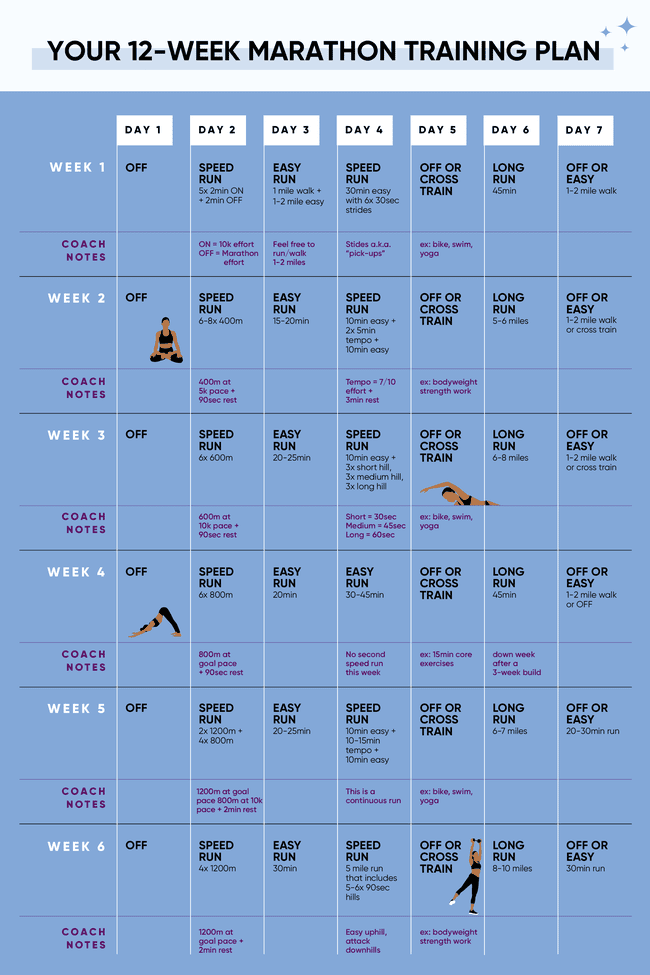
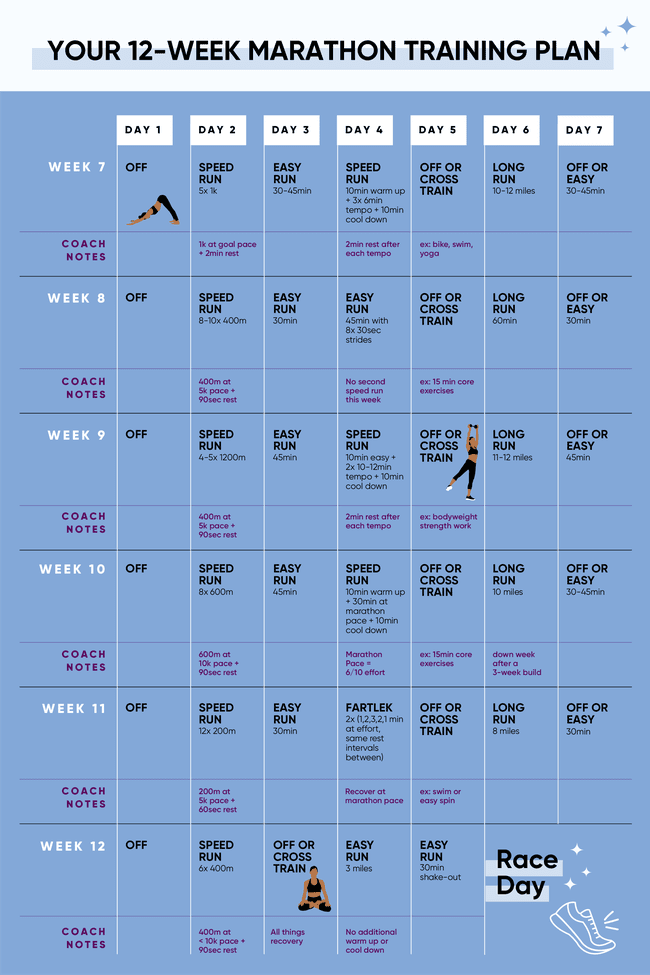
12-Week Half Marathon Training Plan for Beginners
Caitlin-Marie Bergmann Ong
Caitlin-Marie Bergmann Ong