

 Suche
Suche
The best chest workout for women
Despite the fact that pecs are literally the focus, they're pretty easy to ignore, especially in this day and age where butt workouts reign supreme. And chest owners in particular can be guilty of skipping regular chest workouts. "There's a little misconception that because we have breasts, we don't need to train pecs," says Kourtney Thomas, CSCS, a certified personal trainer in Denver. But don't be fooled - training your chest muscles is important for everyone. All humans have a large, fan-shaped pectoralis major muscle on either side of the chest, just beneath the breast tissue. A smaller muscle known as...

The best chest workout for women
Despite the fact that pecs are literally the focus, they're pretty easy to ignore, especially in this day and age where butt workouts reign supreme. And chest owners in particular can be guilty of skipping regular chest workouts. "There's a little misconception that because we have breasts, we don't need to train pecs," says Kourtney Thomas, CSCS, a certified personal trainer in Denver.
But don't be fooled - training your chest muscles is important for everyone. All humans have a large, fan-shaped pectoralis major muscle on either side of the chest, just beneath the breast tissue. A smaller muscle, known as the pectoralis minor, is located in the upper part of the chest, below the pectoralis major muscle. Together, these muscles are called the pectorals and cover the entire chest. As such, they help you stand limply, complete daily tasks, and even breathe easily.
So if you've been neglecting these muscles, it's time to mix some weighted chest workouts into your routine. Find out why your pecs deserve your attention, according to fitness experts, below. Then, if you're inspired to gain some weight, get out your dumbbells and a medicine ball and try this chest workout for women, demonstrated by trainer Jenny Gaither, founder of the Movemeant Foundation. (No weights? Try these resistance band chest exercises instead.)
5 Benefits of Chest Training for Women
1. You improve your posture.
When it comes to posture, the focus is on the back and shoulders. However, as one of the largest muscles in the upper body, the pectoral muscles play an equally important role in maintaining posture and upright stability, namely by supporting the scapula (your shoulder blade) and the shoulder joint itself.
“Any muscle that surrounds the scapula and shoulder is going to be important in stabilizing those joints,” says Joel Seedman, Ph.D., exercise physiologist and owner of Advanced Human Performance in Suwanee, Georgia. “If one becomes weaker, then you have balanced tension across the joints.”
And when a muscle is excessively shortened or lengthened, it doesn't matter whether it is strong or weak - the pectoral muscles cannot do their job adequately. The biggest culprit of foreshortening? Your computer. When you squat over it all day, you're simultaneously shortening your pectoral muscle fibers and lengthening your back muscles, says Seedman. So if you have a desk job, that's all the more reason to incorporate some chest exercises for women into your workout routine. (Related: The Strength Training Routine for Perfect Posture)
2. You will breathe easier.
As you correct your posture, you also open your chest, making it easier to take deep, quality breaths. The pectoralis minor is particularly helpful because the smaller, triangular muscle attaches to the middle of your third, fourth, and fifth ribs. Every time you breathe in, the pectoralis minor muscle stretches, allowing your ribcage to expand.
"When the chest muscles are too shortened, breathing is significantly impaired because you can't open the diaphragm," says Seedman. "But when you lengthen these chest fibers, it significantly improves breathing and the ability to increase oxygen delivery to all of your muscles." An important reason to do chest training with weights.
3. You can make your breasts firmer (if you want).
Seedman says that many women and other breast owners shy away from exercising their breasts because they believe their breasts will shrink, but that's actually the opposite of what can happen - breast training for women is somewhat of a non-surgical method of breast enlargement. (Plus, they might just help you finally conquer that elusive pull-up!)
"They push the breast tissue more up and forward, creating the illusion that your breasts are larger," he says. Plus, adding muscle to your chest helps lift your breasts, “almost like a push-up bra.”
And remember: adding muscle underneath the actual breast tissue does not take away from the breast tissue itself.
4. They make daily activities easier.
Outside of the gym, your chest muscles play an important role in a variety of daily activities, from loading grocery bags into the house to pushing open a heavy door to lugging a suitcase through an airport. “Pretty much every upper body activity or movement we do involves the pectoral muscles to a significant degree,” says Seedman.
The main functions of your pectoral muscles are to flex (lift), adduct (bring back), and medially rotate (turn inward) your upper arm. "So when you think about picking things up, holding things, pushing, or any type of movement that involves pushing, the pectoral muscles are involved in all of that," says Thomas.
This is why simply carrying and loading grocery bags into your house can feel like a challenge if your chest muscles are weak from disuse. From a purely functional perspective, you will make your everyday life easier if you include this chest workout for women in your training plan.
5. You train other muscles.
Sure, pecs are big, important muscles, as explained above. But they're also important because they call into action a number of the surrounding muscles - namely the shoulders, back and triceps - making any chest exercise a fantastic full-body move.
Example: Seedman says that one of the best exercises for strengthening the triceps is actually a chest press. And the research backs it up: A study published in the Journal of Strength & Conditioning Research found that different variations of the chest press are more effective at targeting certain muscle groups than others—including the tris. Using surface electromyography, a method of measuring muscle activation during exercise, researchers found that a dumbbell chest press is best for those looking to build their chest, while a Smith machine or barbell setup is the ideal way to perform the movement if horseshoe gaze in the triceps is the goal. If you're in the first group, be sure to steal some of the best dumbbell chest exercises for women below. (PS These 7 fitness machines are really worth your time.)
The best chest workout for women with weights
You might think that you need a gym full of equipment to do a weighted chest workout, but for this one you only need a few things. You can do this best chest workout for women at home with just a set of dumbbells, a medicine ball, and a Swiss ball. Each of the chest exercises for women below will strengthen the muscles behind your breasts—as well as a number of other key upper body muscles—so you'll come away stronger all over.
How it works:Do 1 set of these chest exercises for women back to back, three days a week, without rest between movements. After the last exercise, rest for 30 seconds and then repeat the entire circuit three more times for a total of 4 rounds.
You need:a pair of dumbbells, a medicine ball and a Swiss ball
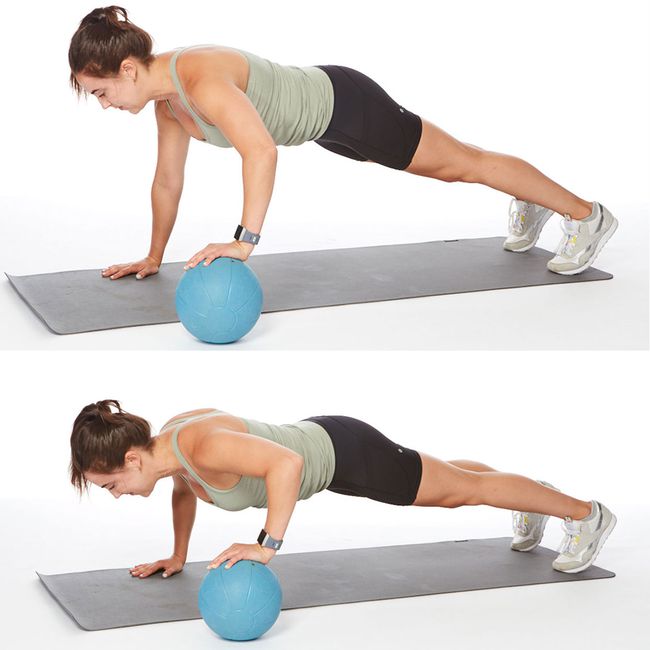
Medicine ball push-up
Peter Ardito
AStart in a push-up position with your left hand on a medicine ball and your right hand on the floor. Tense your legs and pull your belly button up and in.
b.Keeping the body in a straight line, bend the elbows and slowly lower yourself to the floor as far as possible. Push up with both hands to return to the starting position.
Do 8 reps. change sides; repeat.
Chest pass

Peter Ardito
ALie faceup on the floor with your knees bent and feet flat, holding a medicine ball in front of your chest.
b.Keeping your lower back pressed into the ground and core engaged, explosively throw the ball as high into the air as possible. Start with your arms straight and immediately lower your back to your chest to return to the starting position.
Do 20 reps.
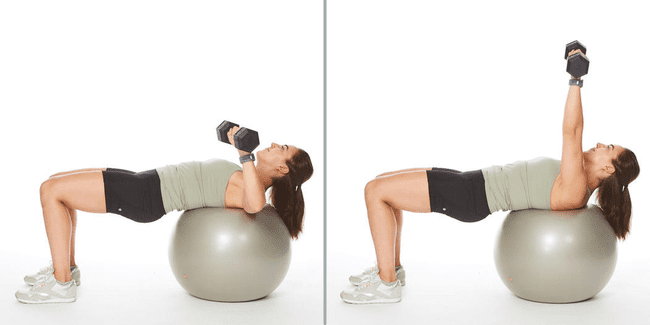
One-arm chest press
Peter Ardito
AHold a dumbbell with your left hand and lie on your back on a Swiss ball. Raise your hips so that your body forms a straight line from your knees to your shoulders. Hold the dumbbell at your chest and pull your shoulder blades down and together.
b.Push the weight straight up, then lower it with your back to your chest to return to the starting position.
Do 8 reps. change sides; repeat.
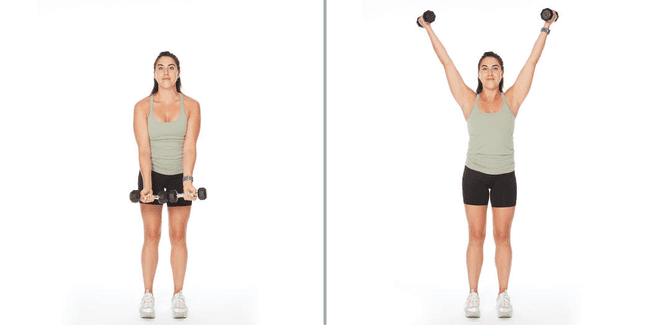
Y Increase
Peter Ardito
AStand upright, feet hip-width apart, knees slightly bent, and hold a pair of light dumbbells in front of your thighs, palms facing away from your body.
b.Keeping your core tight, pull your shoulder blades down and back as you lift the weights overhead in a Y position. Return to the starting position slowly and in a controlled manner.
Do 20 reps.
Renegade Series

Peter Ardito
APlace two dumbbells on the floor, shoulder-width apart. Start in a tabletop position with your shoulders stacked over your hands, each gripping a dumbbell. The knees are bent and stacked directly under the hips.
b.Step one leg back at a time to get into a high plank position on the palms of your hands. The feet should be slightly wider than hip-width apart. Activate the quads, glutes, and core and slightly tuck the tailbone.
CPull your shoulders down and away from your ears and slowly bend one elbow back, keeping your arm close to your side as you pull the dumbbell up toward your hip. Be sure to keep your hips stable and avoid swaying sideways.
DReturn to the starting position and gently place the dumbbell down. Repeat the row on the opposite arm. This is a repeat.
Do 8 reps.
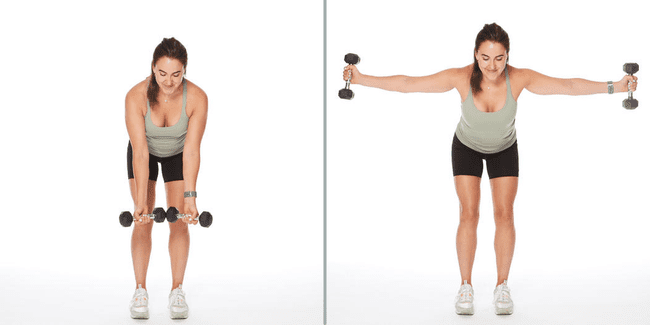
Rear lateral raises
Peter Ardito
AStand with your feet hip-width apart and hold the dumbbells with your palms facing forward. Bend your knees, shift your hips back, and bring your torso parallel to the floor.
b.Without moving your upper body, raise your arms straight to your sides to shoulder height. Pause, then slowly return to the starting position.
Do 20 reps.