

 Suche
Suche

There's a risk that you'll read just one sentence and then leave this page, but it's worth making sure this point is clear:You willnotWeight gain due to too few calories.
If you learn nothing else from this post, let it be. But there's so much more that explains why (and how) malnutrition can seemingly lead to weight gain.
One of the hardest parts of dieting - which happens to almost everyone - is the moment when you get frustrated with weight loss and try to cut calories even more to get back down the scale.
And what happens? They seem to beextractionWeight.
It's incredibly frustrating and you insist that your body must be broken, or maybe it's the gluten... or dairy... or artificial sweeteners that are making you fat. But artificial sweeteners aren't to blame and your body isn't broken.
3 Reasons You Gain Weight (When You Least Expect It)
So what's going on? Precision Nutrition has given many reasons why it seems this way Malnutrition can lead to weight gain, although it is not the case.
In our experience with Online coaching clients We've seen everything. But when it comes to weight loss, there are three common reasons why you continue to struggle with weight loss even when it seems like you're doing everything right.
Ultimately, everyone's concern is the way it's easy to misunderstand calories. As mentioned earlier, you cannot underestimate your journey to weight gain. But you canappeareating too little and still gaining weight.
We want to make sure you can easily identify any sneaky ways you can be tricked into following a diet that only leads to additional frustration (and a scale that won't move).
Foods with hidden calories
Whether you're a diet professional or don't know the difference between carbs and proteins, hidden calories suck and they're everywhere. The Precision Nutrition article included the following example that we have seen hundreds of times:
I once had a customer discover that he was using ten tablespoons of olive oil - 1200 calories - instead of the two tablespoons - 240 calories - that he thought he was using in his pan. Oops.
It's frustratingly easy for hidden calories to quickly pile up day after day, week after week, and that's all you need to stay at a plateau or even gain weight despite your best efforts.
Instead of worrying about counting calories, it's important to easily see where most of the hidden calories usually are.
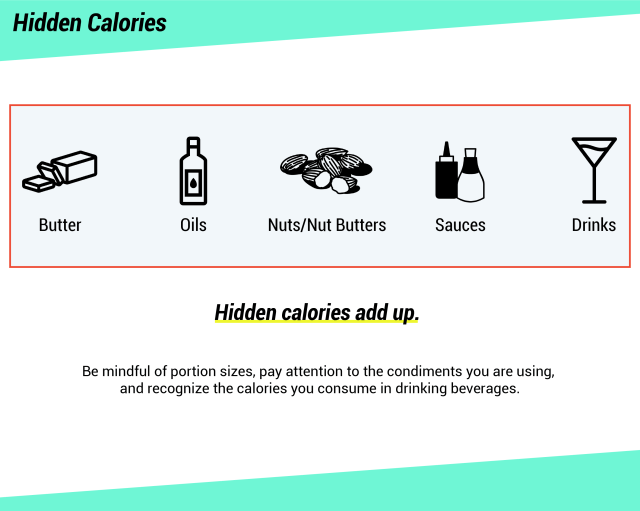
Check out the graphic below to help you think twice while eating. What makes all of these hidden calorie foods so difficult is that they are high in calories. That means even if they're healthy for you (which some of them are), just a small serving contains a large amount of calories, which is why it's so easy to eat a lot more than you thought.
How much does a 2,000 calorie diet cost?
Since very few of us spend our time measuring and weighing food (and rightly so), it can be shocking to learn how much we underestimate the number of calories we consume per day.
And that Research supports it. On average, people underestimate their calorie intake by 30 percent, and sometimes they can even underestimate it by 45 percent. That makes a big difference.
And to be fair, many people will give the impression that this is an educational issue, but even professionals can't tell how much food is in a meal. A typical example:
A few years ago, Dr. Berardi (JB, as he is known here) eats with some friends at a well-known restaurant chain. He ordered one of their “healthier” meals, which emphasized protein, vegetables, and “clean” carbs. Then he finished dinner with cheesecake. Curious to see how much energy he had used, he looked it up.
Five. Thousand. Calories.
I had the same problem. And it can be little things. Like how my “1 scoop” of Justin’s maple almond nut butter is closer to eating half a jar, but I could count 1 scoop. You may not keep track, but your body will.
Calories in, calories out is confusing
Yes, this law of thermodynamics is still the main determinant of weight loss or weight gain. But what counts as “calories in” or “calories out” isn’t that simple.
For example, all of the following factors can affect your "calories in" equation: the composition of your meals (protein, carbs, fats), your body type, the amount of muscle/amount of body fat, hormones, genetics, your environment, how you slept last night, stress, and much more.
Let's just take a small example. When you eat a meal, each type of food has a different “thermal effect of food,” or TEF. This is the rate at which your body metabolizes a meal. In other words, it's how many extra calories you burn when you eat a particular food.
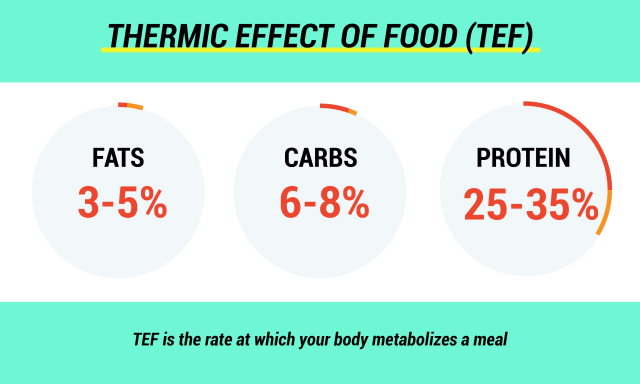
Protein has the highest TEF, which is between 25 and 35 percent.
In comparison, carbohydrates are only 6 to 8 percent and fats are the least metabolically active with a TEF of around 3 to 5 percent.
That means if two people each eat a 500-calorie meal, but one person has more protein and the other person has more fat, the calories-in model will look different for each person, even if they have the exact same number of calories.
All of this means that many factors determine how your body stores (and burns) calories. So when frustration sets in, don't give up, don't try to be perfect, and remember that there's no point trying to outsmart the system.
It's not that we lie (although we can sometimes deceive ourselves and others about our intake). Above all, we have difficulty estimating portion sizes and calorie counts. This is especially difficult today when plates and portions are larger than ever before. And energy-dense, incredible-tasting, highly brain-rewarding “foods” are ubiquitous, cheap, and socially encouraged.
Instead, look for a diet that you think you can follow. And as you begin, add checks and balances to hold you accountable and support to eliminate the need for “perfection.” And then other systems that make sure you don't overeat without your own knowledge.
If you need help finding the right diet or someone to help you with these reviews,Our online coaching program may be right for you. Each client is assigned two trainers – one for nutrition and one for fitness. Find out more here.
Have any questions? Share them in the comments below.
Topics of the next articles:
Should I cut out alcohol to get rid of fat?
Why am I hungry all the time?
The Beginner's Guide to Fat Loss