

 Suche
Suche
What Society Gets Wrong About the Angry Black Woman” Stereotype
Close your eyes and imagine an angry black woman. It only took a moment to imagine her, right? The picture is complete: a hand on her hip, a finger in her face, swiveling her head and neck. You can probably hear their black English. She probably seems intimidating to you. She is oversensitive and masculine. She is easy to anger and difficult to calm down. She is aggressive and irrational, too loud and too much. She's not real either. Let me repeat: The image of the Angry Black Woman (ABW) that so easily pops into your head...

What Society Gets Wrong About the Angry Black Woman” Stereotype
Close your eyes and imagine an angry black woman. It only took a moment to imagine her, right? The picture is complete: a hand on her hip, a finger in her face, swiveling her head and neck. You can probably hear their black English. She probably seems intimidating to you. She is oversensitive and masculine. She is easy to anger and difficult to calm down. She is aggressive and irrational, too loud and too much.
She's not real either. Let me repeat: The image of the Angry Black Woman (ABW) that so easily pops into your head is as false as a fairy tale. It is imaginary, but it is by no means a coincidence. It - the trope - is designed to control and undermine black women, to punish us when we express even mild and reasonable indignation, pain, or annoyance (let alone anger), and to protect a status quo in which black women and girls often find themselves treated as interchangeable, irrational problems rather than as people with very reasonable grievances.
The figure of the angry black woman goes back a long way. I see its roots in slavery, when expressions of black female anger, particularly against white people, were deeply justified but also illegitimate. In a culture and economy that depended on viciously controlling black women's bodies and lives, it made economic sense to portray black women's anger as unreasonable and ugly, rather than a rational response to subordination and humiliation.
Once we are seen as angry, the “Angry Black Woman” stereotype views that anger as explosive, irrational, and frightening.
The trope found its way into minstrel shows, where white men donned blackface and fat suits to play boorish and brooding caricatures of black women. It moved from 18th- and 19th-century white fantasy to 20th-century entertainment, appearing in dramas like “Gone with the Wind” and comedies like “Amos ‘n Andy.” Popular entertainment from the 1990s, including The Jerry Springer Show and Ricki Lake – which I consumed as a child – helped reinforce the stereotype. In recent years, our culture has pinned the derogatory label ABW on Michelle Obama, Serena Williams, Kamala Harris, Shonda Rhimes, Congresswoman Maxine Waters, Meghan Markle, Jemele Hill, and many others in response to the kind of truth-telling, creativity, and demands for self-respect that we often welcome in others. Each of these women has hard-won power and an authoritative voice—but we as a culture often don't want to hear what Black women have to say.
I wish I could say that there is an area of my life, or that of every black woman I know, that remains untouched by the ABW stereotype, but I can't. It shows up in work meetings, even though I intentionally smile and measure my tone when giving feedback. It shows up in personal relationships as I try to address the emotional damage I am experiencing. It shows up as a reaction to my writing when I've been told my voice is too convincing or too offended. It even shows up in therapy (if I'm not allowed to speak up there, where can I?). The ABW stereotype is so pervasive that even the smallest gesture of sternness, dissatisfaction, strength, or rejection can be mislabeled as “anger” when it comes from a Black woman. And once we are seen as angry, the ABW stereotype considers this “anger” to be explosive, irrational, and frightening.
Caitlin-Marie Bergmann Ong
To avoid these scenarios, I, like many Black women, carefully monitor my facial expressions and body language to ensure I sound calm and reasonable, calibrating myself within a narrow register designed not to frighten or offend those in power. It's exhausting. It's dehumanizing. It cuts into my sense of worth and well-being. I can't say for sure that it contributes to my anxiety - something I've lived with since I was a teenager - but anxiety is, in part, a feeling of unease or uncertainty about how things are going to go, a feeling that you're not entirely sure, and the ABW caricature puts endless pressure on me to show niceness in order to seem nominally safe and likeable in a world that doesn't particularly like or protect black women and girls remain. How could this not feed my chronic feelings of insecurity and unease? (See also: How Racism Affects Your Mental Health)
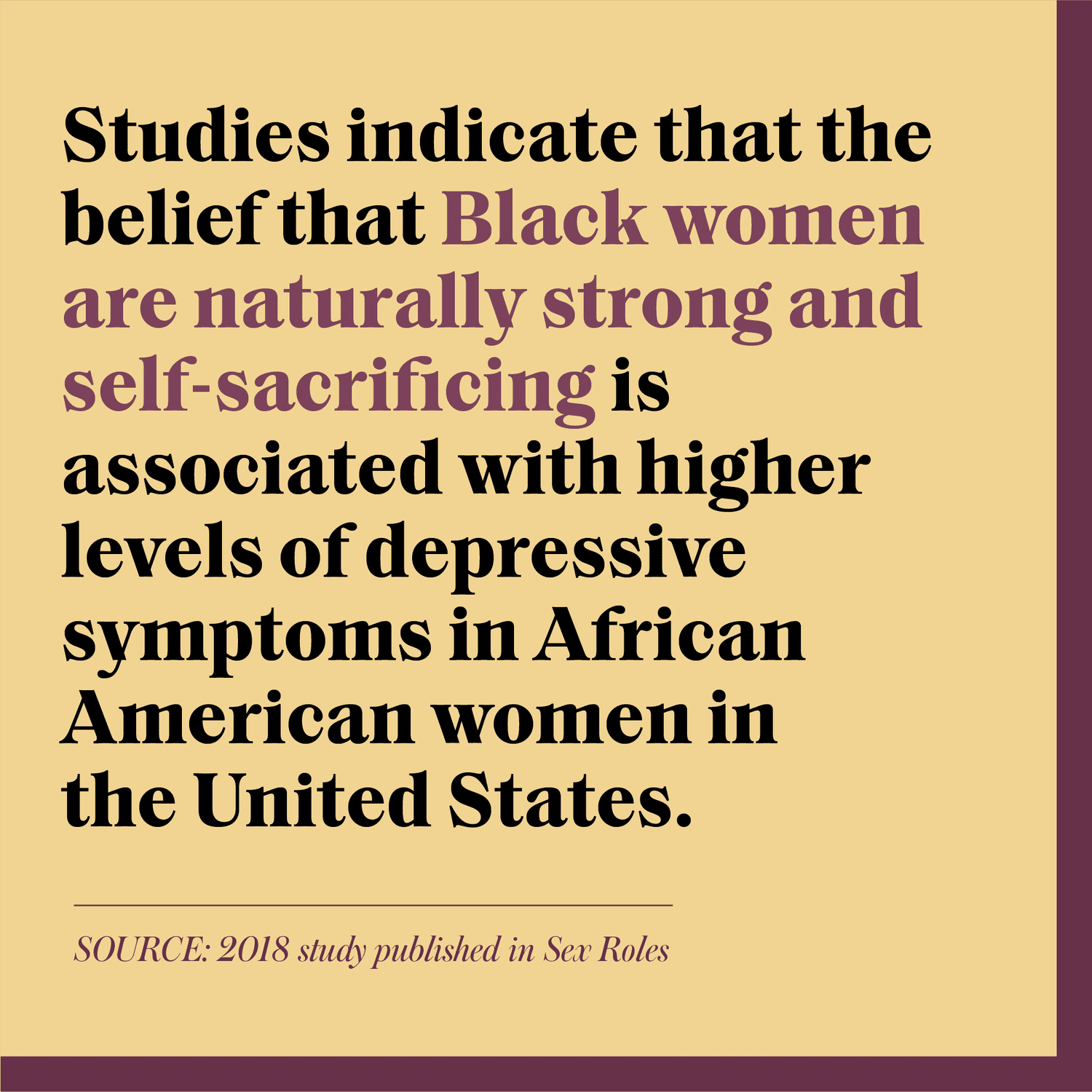
There are quantifiable consequences for living in a culture that imposes a demonizing stereotype on people who express normal human emotions. Instead of showing your anger, you smother it - and it burrows inside and hurts. Psychological problems such as depression, anxiety and higher levels of stress are often the results of suppressed anger. And according to the Anxiety & Depression Association of America, anxiety in black women is more chronic and has more intense symptoms than their white counterparts. Studies show that Black women are less likely to seek help for anxiety and depression and, when they do, are at higher risk of ineffective and harmful treatment.
There's a physical component, too: The allostatic load that Black women carry, including repressed anger, can lead to physical health problems that disproportionately affect Black women, such as high blood pressure, heart disease, diabetes-related deaths, and even breast cancer mortality rates—none of which are good for anxiety and depression. I can't help but wonder if we are less likely to ask for help because we know that the world often misinterprets our insistence, our urgency, and our truth-telling as irrational, frightening, and shrill. And I can't help but wonder how often the same misinterpretation leads to poor care from mental (and physical) health professionals. (
Why the USA urgently needs more black female doctors
The fact is, as Solange says, we have a lot to be angry about. Structural racism and anti-Black bias in every aspect of our lives means that we often don't have the same fair opportunity as our white (and non-Black) counterparts, no matter how hard we try. We are more likely to die during childbirth; we make less money; we accumulate less wealth; we are overrepresented in prisons and underrepresented in the corporate world; we have less success with dating apps; we are less likely to get married (and reap the financial, physical, and spiritual benefits that often accompany long-term relationships); we are less likely to get painkillers when we go to the doctor; We are less likely to be invited to an interview if we have names that “sound black”; we are more likely to be stopped by the police; We are more likely to be targeted by unscrupulous banks – the list goes on. None of this is because we are unworthy, untalented, or unfocused. That's because we are Black women, and despite our contributions to art, science, politics, law, philosophy, cuisine, sports, spirituality, music, and the making of this country, mainstream society doesn't care about us or care about others. Of course we are angry.
Instead of listening to us and responding, society constantly says the problem is our “lack of manners” or “oversensitivity” rather than structural inequalities. This is why the “Angry Black Woman” stereotype was created and why it still exists.
Still, the ABW stereotype means that other people see us as irrational and confused when we express anger or dissatisfaction. It is so pervasive that even emotions that are not anger (e.g., severity, dissatisfaction, strength, and rejection) are mislabeled as “anger” when they come from Black women. Instead of listening to us and responding, society constantly says the problem is our “lack of manners” or “oversensitivity” rather than structural inequalities. That's what the ABW stereotype was developed for, and that's why it still exists. As long as we live under the rule of racial and gender hierarchy, stereotypes that demean Black women will thrive.
Now close your eyes and imagine an actual angry black woman — not the trope. Can you? Can you see them without the preconceived cartoonish distortion? Let me help. This woman may be crying in pain. She may be at the height of her power, righteous and right, doing what white men do all the time: express herself. She may be a mother, and her “anger” is actually just the grit and determination that defines that role. She may be your boss and her “anger” is actually just honesty about your performance. Maybe she just suffered a racial insult, or her anger has nothing to do with race at all. She may have every right to be angry, much angrier than she looks or expresses. She may also feel scared, alone and powerless. Or annoyed, impatient and overwhelmed. Or courageous, energized and in joyful self-control. She's also undoubtedly as strategic and thoughtful as possible, aware that the ABW stereotype makes people less likely to take her seriously and more likely to be afraid of her than afraid for her, even if she's the one who so often suffers the danger.
A truly angry black woman is multidimensional, not flat, not easily summed up by one trope. She is a complex, sophisticated, intelligent person, not a caricature. She has the right to feel and show the full range of human emotions. And she is entitled to your respect while she does it. So let me offer an alternative vision of black female rage. There is a world where we consider black women's anger to be beautiful. Beautiful as a response to racism, misogyny and injustice everywhere. Beautiful as an act of resistance and creation – resistance in the face of systemic prejudice against Black people and women and at the same time something propulsive, political and generative, something that gives us all space to witness and explore the full depth of our shared humanity.
There is a world where black female rage is a tonic we can all drink. This world exists on the other side of demonizing, inaccurate stereotypes; we can do it. It's a world where we care about how black women are doing and where we want to hear them speak.
The inextricable connection between black women, dance and mental health